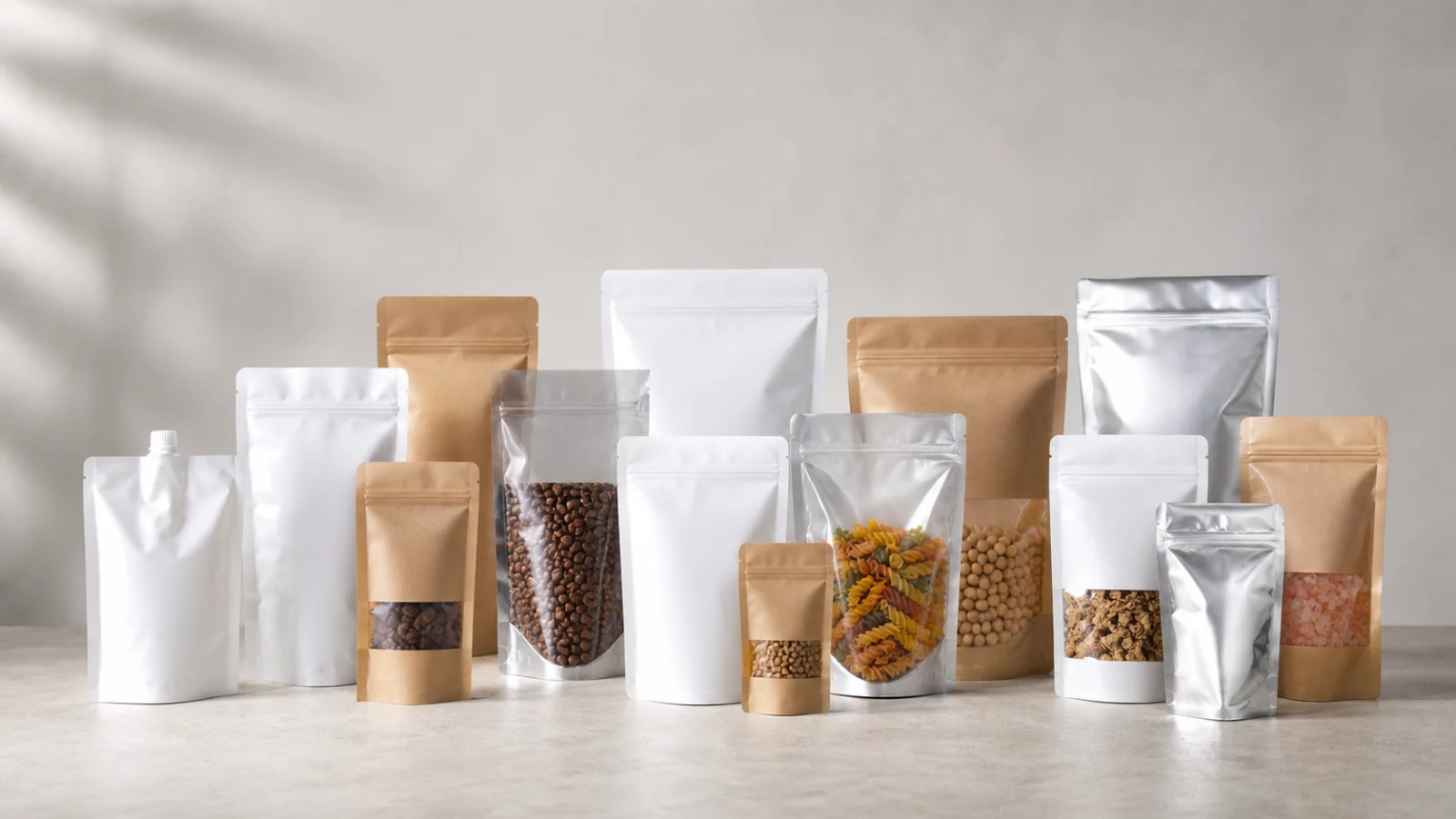
A stand-up pouch, also called a doypack, is a flexible package with a bottom gusset that opens into a supporting base after filling. It provides front-facing shelf display while shipping and storing flat before use.
The format looks simple, but the buying decision is not. Product density, laminate structure, barrier needs, dimensions, closures, filling equipment, and final sealing conditions must work together.
Before comparing quotations, buyers should understand how these variables affect stability, shelf life, filling-line fit, and seal quality. The sections below explain what to specify, what to test, and what information a supplier needs.
How Does a Stand-Up Pouch Stand Upright?
A stand-up pouch stands because its folded bottom gusset expands during filling and forms a base beneath the product. The contents provide much of the finished shape, while pouch width, gusset depth, material stiffness, fill level, and product distribution determine its actual stability.
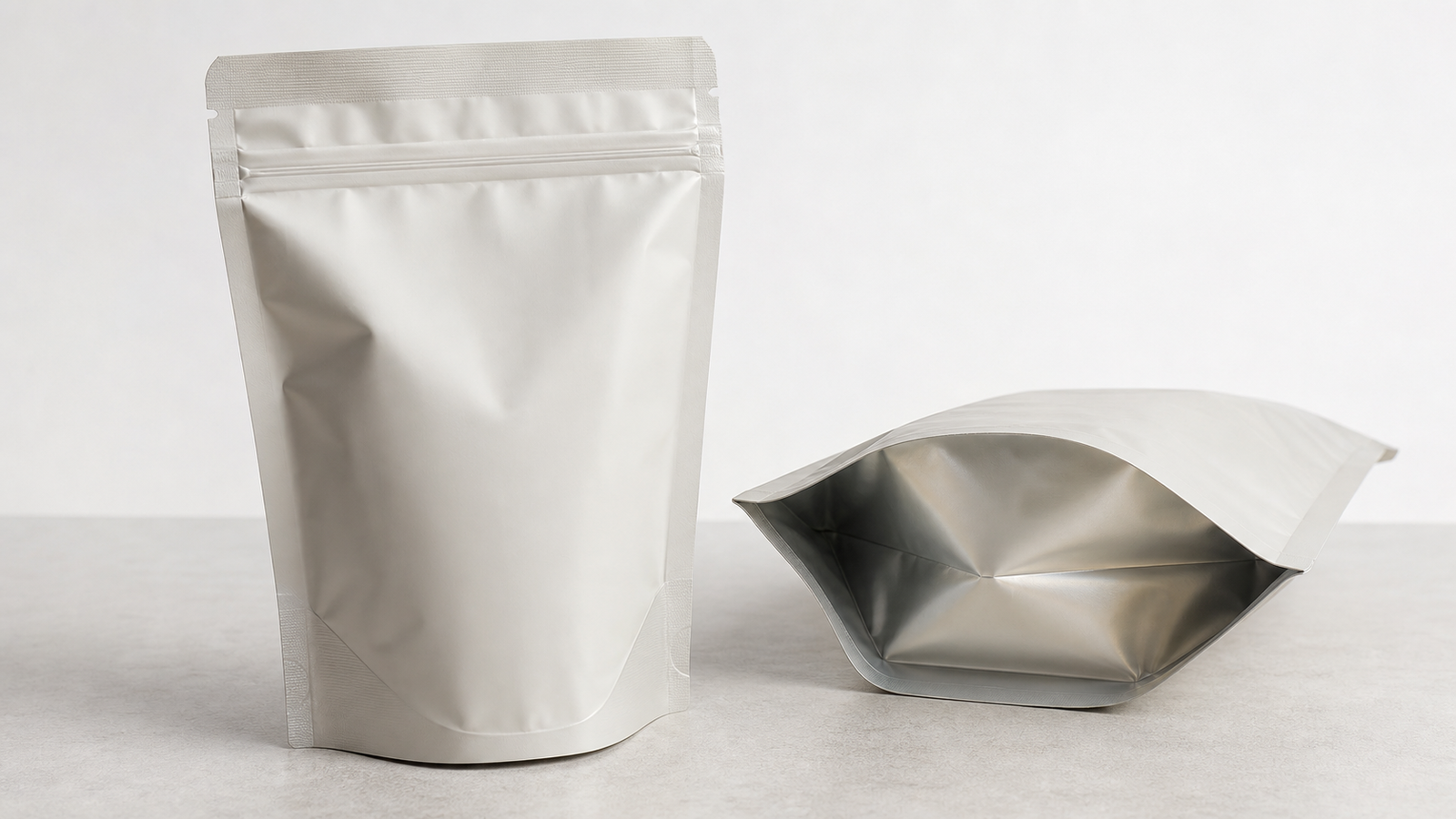
An empty stand-up pouch is usually supplied flat, with the bottom film folded between the front and back panels. As product enters, it pushes the gusset outward and creates a footprint that supports the filled package.
“Stand-up” describes the intended filled format, not necessarily the empty bag. Even a pouch with a broad gusset can lean or collapse if the product settles unevenly, the fill level is too low, or the pouch is too tall and narrow for its contents.
| Buyer question | Stand-up pouch | Three-side-seal pouch |
|---|---|---|
| How is the bottom made? | Expandable bottom gusset | Straight bottom seal without a formed base |
| How is it displayed? | Intended to stand after filling | Usually lies flat or hangs |
| What changes on the line? | Gusset affects pickup, opening, nozzle access, and filling | Flatter opening geometry may be simpler to handle |
| What should be approved? | Filled shape, base expansion, stability, and seal clearance | Filled profile, seals, and display method |
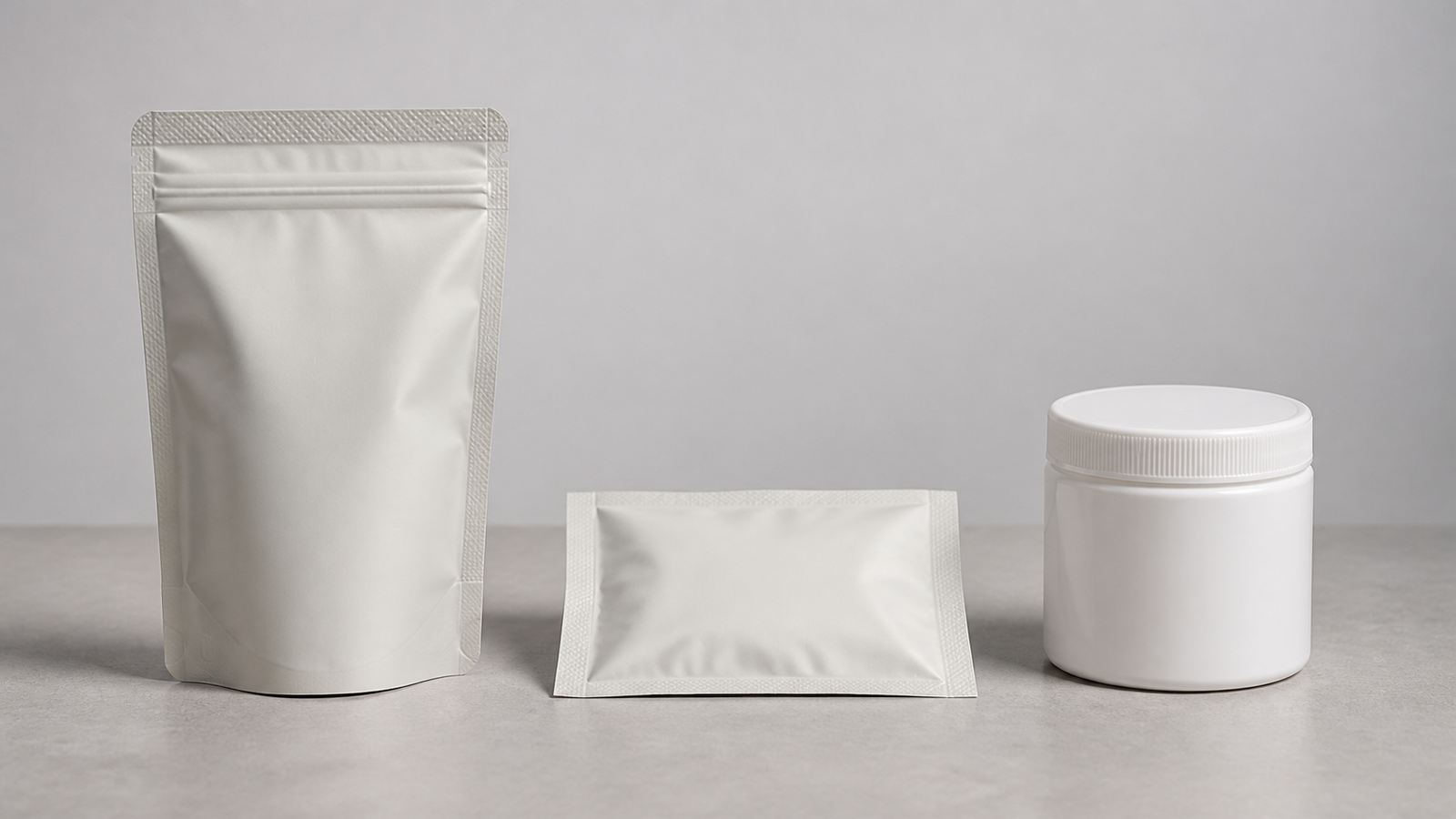
A three-side-seal format comparison1 is useful when shelf display is the main reason for changing packages. The added gusset provides a standing base, but it also changes material use, opening geometry, and machine handling.
I would approve the shape with a representative filled sample, not an empty pouch or drawing alone. Check that the gusset opens fully, the product settles into the base, and the front and back panels remain presentable after routine handling. Fill weight, bulk density, particle shape, pouch width, height, and gusset depth all affect the result.
Which Laminate Structure Should You Choose?
Choose the laminate by matching each layer’s job to the product, shelf-life target, filling process, and distribution environment. PET/PE, PET/ALU/PE, and kraft/PET/PE are useful structure descriptions, but they do not replace documented barrier, thickness, and sealing information.
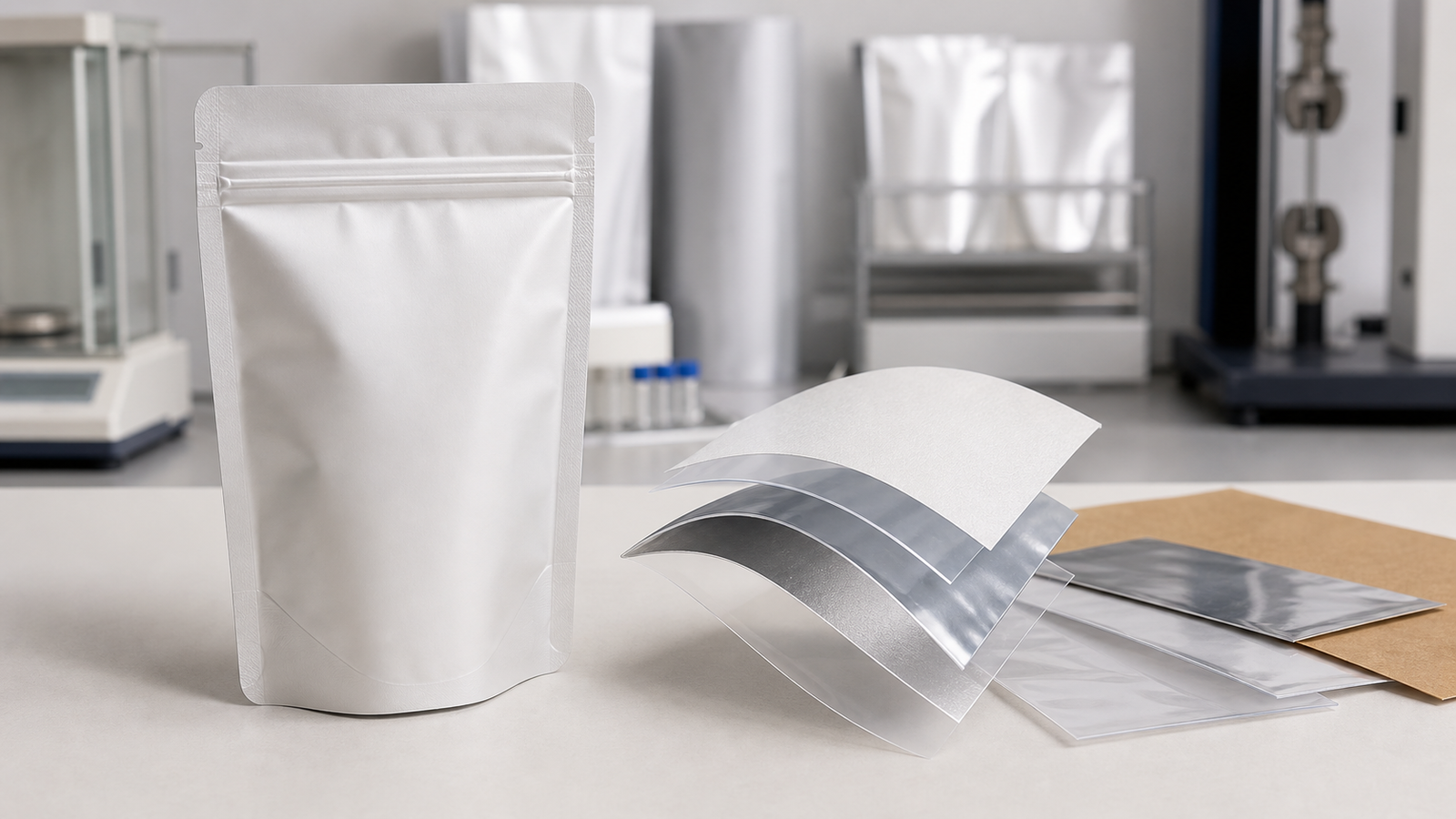
A laminate combines materials because one layer rarely delivers printing, stiffness, barrier, product contact, and heat sealing by itself. The outer layer commonly supports graphics and handling. A middle layer may control oxygen, moisture, or light. The inner layer contacts the product and forms the seals.
| Example structure | Functional roles | Buyer checks before approval |
|---|---|---|
| PET/PE | PET provides a printable outer surface and stiffness; PE provides the sealant layer | Confirm thickness, required barrier, product compatibility, and sealing window |
| PET/ALU/PE | PET supports printing; aluminum adds oxygen and light barrier; PE seals | Confirm whether foil is necessary and whether windows or fitments change protection |
| Kraft/PET/PE | Kraft supplies the paper appearance; PET supports the laminate; PE seals | Confirm the complete barrier structure and intended end-of-life route |
These are structure examples, not performance guarantees. Film grade, individual layer thickness, adhesive, converting quality, seals, windows, valves, and fitments can all influence the finished package. Total thickness should be recorded with the complete layer structure rather than used as shorthand for durability or barrier.
OTR means oxygen transmission rate. WVTR means water vapor transmission rate; some suppliers use MVTR when discussing moisture transmission. When reviewing oxygen transmission rate testing2, ask for the units, method, temperature, and relative-humidity conditions. Results obtained under different conditions may not be directly comparable.
The sealant also needs a practical sealing window: the combination of temperature, pressure, and dwell time that produces an acceptable seal on the intended equipment. I would request the full laminate, total thickness, barrier data with test conditions, and initial sealing guidance before approving the structure.
Is a Stand-Up Pouch Suitable for Your Product?
A stand-up pouch is suitable when its shape, laminate, seals, and dispensing features match the product’s form, density, fill volume, processing, handling, and storage conditions. Dry goods are common applications; liquids, heavy fills, hot-fill products, and retort products need application-specific structures and testing.
Snacks, coffee, tea, pet treats, powders, supplements, and other dry products commonly use stand-up pouches. The format provides broad display panels and can incorporate barrier layers, zippers, valves, or other features suited to the contents.
The same standard zipper pouch should not be applied to every product:
| Product or process | Likely format direction | Main technical questions |
|---|---|---|
| Dry pieces or powders | Standard stand-up pouch, with or without zipper | Does the product generate dust, trap air, or require moisture protection? |
| Liquids or slurries | Spouted pouch or another controlled-dispensing format | How will it be filled, sealed, capped, dispensed, and checked for leakage? |
| Heavy fills | Application-specific pouch and seal design | Will the base and seals tolerate expected filling and handling stresses? |
| Hot-fill or retort | Structure designed for the stated thermal process | Are the laminate and seals compatible with the actual process conditions? |
Example: Equal Net Weight, Different Pouch Volume
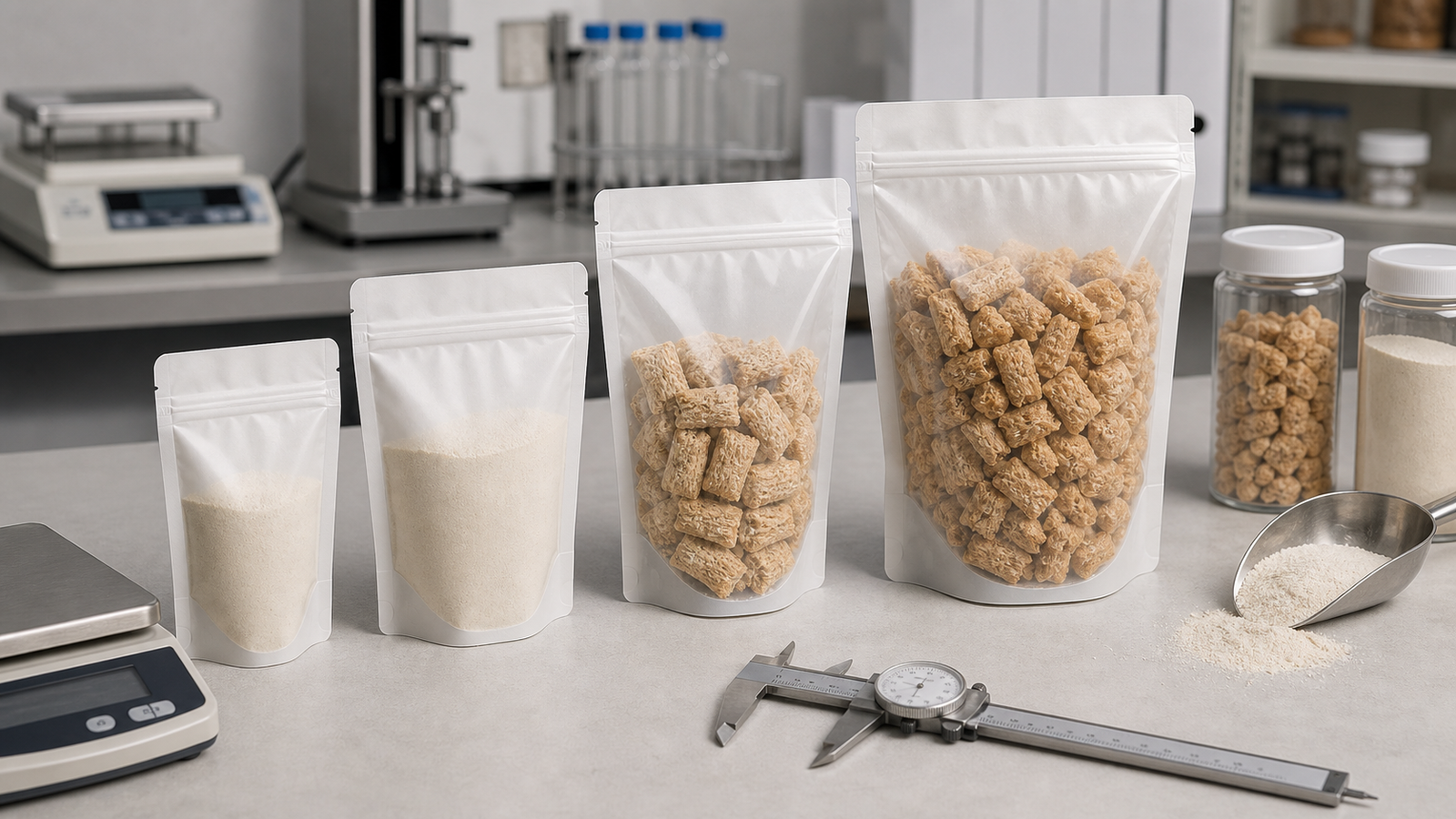
This is a teaching scenario, not a customer case. For example, compare equal net weights of dense powder and irregular snacks. The powder may settle into a compact volume, while the snacks occupy more space and retain air between pieces. Using one pouch size based only on weight could leave the powder package slack and unstable or the snack package too full for reliable sealing.
Net weight measures mass, not occupied volume. Bulk density measurement3, particle shape, trapped air, settling, and required headspace all influence pouch dimensions.
Provide representative product, measured volume, or dependable bulk-density information before fixing the size. A fill trial should confirm headspace, gusset expansion, shelf appearance, nozzle access, and top-seal clearance under normal production conditions.
Which Bottom Style and Pouch Features Do You Need?
Choose the bottom style and added features according to how the pouch must stand, fill, open, dispense, reclose, and display. K-seal, Doyen, plow, and corner-seal bottoms create different geometries, while every zipper, spout, valve, window, or hang hole should serve a defined function.

Bottom construction should be selected after the product volume, density, target fill weight, pouch proportions, and filling method are understood. K-seal, Doyen, plow, and corner-seal designs form the lower pouch differently, which can influence base shape, fill behavior, and shelf presentation.
Face width and gusset depth must work together. A deeper gusset may add internal volume, but it cannot correct every dimensional problem. The pouch still needs suitable headspace, balanced proportions, stable product distribution, and geometry the filling equipment can open and control.
Add features only when they solve a specific requirement:
- Zipper: Allows reclosing after initial opening. Check its position against the fill level, tear line, and final top-seal area.
- Tear notches: Provide an opening point and must align with the intended opening path.
- Hang hole: Supports peg display but occupies top-panel space needed for seals and artwork.
- Clear window: Provides product visibility while changing the light and barrier strategy in that area.
- Spout or fitment: Supports controlled dispensing and introduces filling, insertion, capping, and sealing considerations.
- One-way degassing valve4: Allows gas released by products such as coffee to leave the pouch. Its location must suit the product level, package panels, and artwork.
I would start with the user action and work backward. If the package must reclose, pour cleanly, hang, vent gas, or show the product, define that requirement first. Each feature adds another interface that must be converted accurately and checked during filling and final package approval.
How Should You Specify Barrier Performance?
Specify barrier by defining the product’s sensitivity, required shelf life, distribution environment, and need for oxygen, moisture, and light protection. Kraft paper, clear film, metallic appearance, or a general “high barrier” description does not establish whether a finished pouch is suitable.
Begin with what can cause the product to deteriorate. Oxygen may contribute to oxidation in sensitive foods. Moisture entering or leaving the pouch can affect texture, flow, or product condition. Light exposure may also matter, particularly when an opaque structure is being considered.
State the target shelf life and expected storage and distribution conditions in the RFQ. The supplier can then propose a structure and provide relevant OTR and water vapor transmission rate5 data. Ask for the test method, units, temperature, and relative humidity. A value measured under one set of conditions should not be treated as universal performance in a different environment.
Example: Clear Window and Barrier Trade-Off
This is a teaching scenario, not a customer case. For example, suppose a foil-containing pouch is selected and a clear window is added later for product visibility. The transparent area no longer provides the same light-blocking function as opaque foil. Its oxygen and moisture barrier also depends on the selected clear film and how the window is constructed.
The revised package should be reviewed using the complete laminate, not the original opaque specification. The same principle applies when valves, spouts, or other components become part of the finished barrier system.
A common specification mistake is asking for “high barrier” without giving the supplier a shelf-life target, product sensitivity, or distribution environment. That wording does not define a measurable requirement. Barrier data helps narrow the structure, but final approval should include appropriate product shelf-life work, seal evaluation, and distribution checks using the finished pouch.
Should You Buy Premade Pouches or Use Rollstock?
Choose premade pouches when the line will pick, open, fill, and seal converted bags. Choose rollstock when suitable form-fill-seal equipment will make the pouch inline. Equipment capability, production volume, changeovers, feature complexity, web or pouch handling, and sealing control should drive the decision.
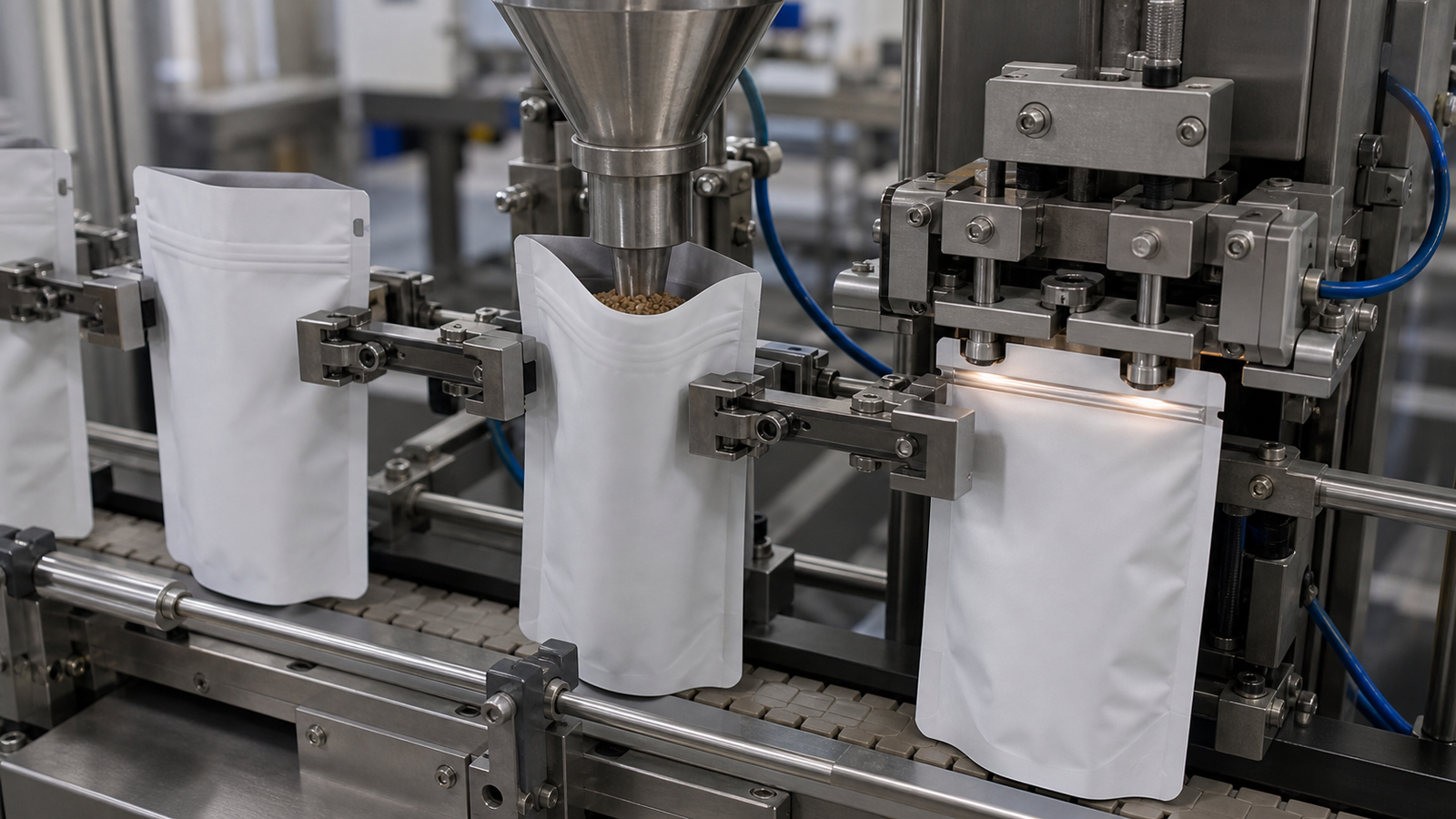
Premade pouches arrive with the bottom gusset, side seals, and specified features already converted. A rotary or other premade pouch filler typically removes each pouch from a magazine, opens it, fills it, and applies the final top seal.
Rollstock arrives as a continuous web. The packaging line forms and seals the pouch as part of production. Horizontal form-fill-seal equipment6 is commonly associated with doypack production, while capable vertical systems can also produce gusseted stand-up formats. Confirm the exact geometry and features a machine can run; the labels HFFS and VFFS alone are not enough.
| Production issue | Premade pouch | Rollstock form-fill-seal |
|---|---|---|
| Pouch formation | Completed by the converter | Completed on the packaging line |
| Line handling | Magazine pickup, gripping, opening, filling, and top sealing | Web unwinding, tracking, forming, filling, and sealing |
| Feature availability | Features are built into the converted pouch | Features depend on machine and web configuration |
| Changeover work | Pouch magazine, grippers, guides, and recipes | Forming parts, web setup, registration, and recipes |
| Trial focus | Opening reliability, nozzle access, filling, and top seal | Web tracking, forming accuracy, seal formation, and final geometry |
Do not compare the routes on material price alone. Equipment investment, labor, maintenance, waste, output requirements, changeover frequency, and order volume contribute to the real production decision.
For an existing flat-pouch line, I would check magazine size, gripper position, opening devices, nozzle clearance, zipper handling, and gusset depth. A controlled machine trial with the intended product is the sound basis for approval.
What Should You Test Before Approving the Pouch?
Test the pouch with the actual product, intended filling equipment, planned sealing settings, and relevant distribution conditions. Approval should confirm reliable opening, fill control, gusset expansion, shelf stability, feature clearance, clean seals, barrier suitability, and realistic handling performance rather than appearance alone.
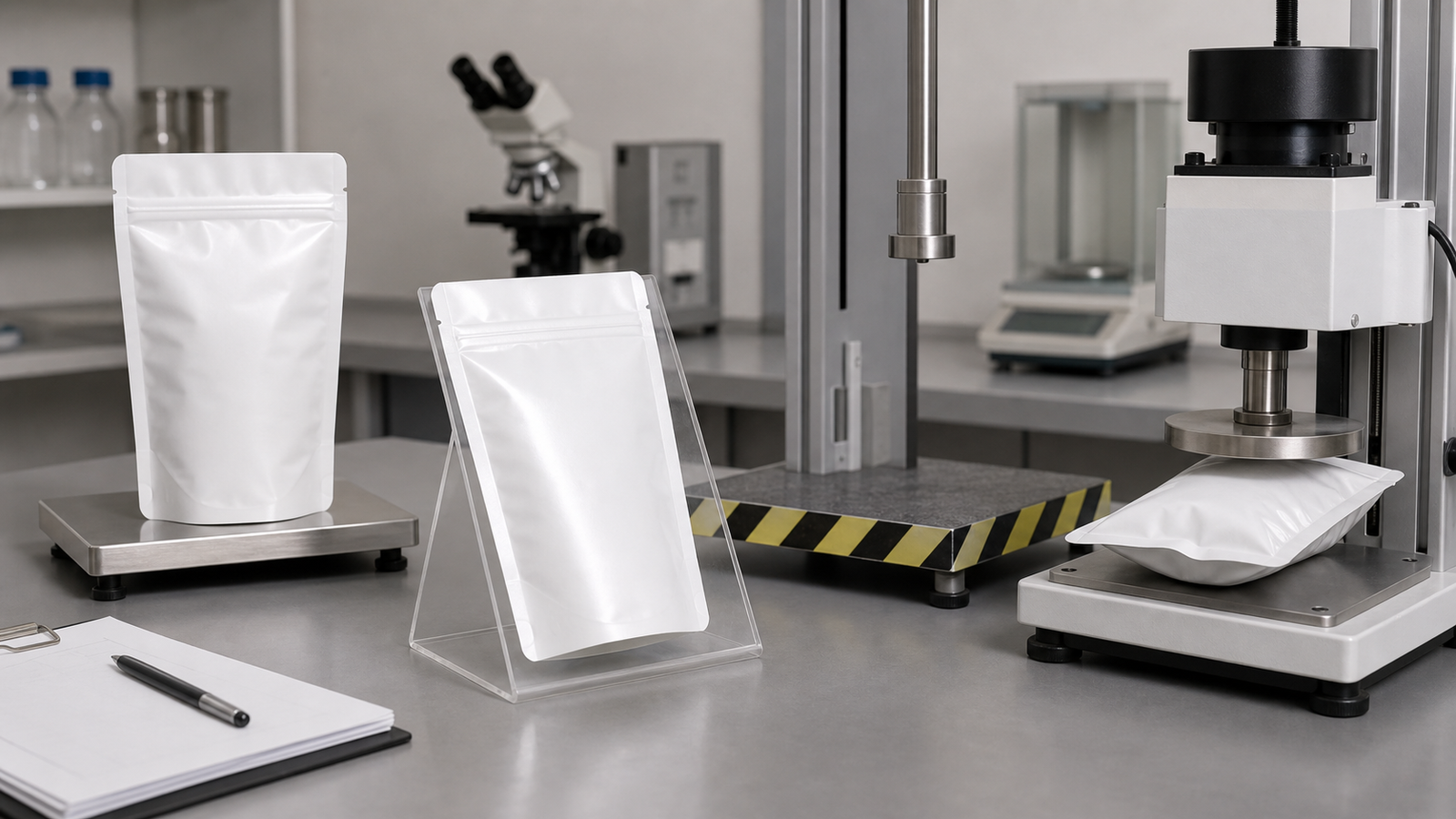
A drawing can confirm dimensions and artwork positions, but it cannot show how the product flows, settles, contaminates the seal area, or behaves on the filling line. Move from dimensional review to filled samples and then to an equipment trial.
Use this approval checklist:
- Confirm that the pouch feeds, indexes, grips, and opens consistently.
- Check that the filling nozzle clears the zipper, panels, and gusset.
- Observe whether the product bridges, foams, traps air, generates dust, or leaves oil near the seal.
- Verify fill accuracy and usable headspace after normal settling.
- Confirm full gusset expansion and stable shelf presentation.
- Inspect the final seal for folds, wrinkles, channels, and product contamination.
- Check that temperature, pressure, and dwell time remain within a workable sealing window.
- Operate the zipper, tear notches, valve, spout, or other features as intended.
- Plan shelf-life and distribution checks around the project’s actual conditions.
Example: Zipper and Top-Seal Clearance
This is a teaching scenario, not a customer case. For example, a pouch may have enough total volume, yet the filled product can rise too close to the zipper. Powder, crumbs, or pieces then enter the area reserved for the final seal, reducing the clean film available for consistent closure. Possible corrections include changing pouch height, fill volume, zipper position, or filling control.
Where formal flexible package seal testing7 is required, define the method and acceptance basis for the project rather than applying an unsupported generic threshold. Record the approved laminate, thickness, dimensions, feature positions, machine settings, and reference sample.
What Information Should a Stand-Up Pouch RFQ Include?
A complete stand-up pouch RFQ identifies the product, fill weight and volume, density, shelf-life target, distribution conditions, filling method, dimensions, material or barrier needs, features, artwork, and quantity. These inputs let suppliers recommend and price a defined application instead of guessing at a generic pouch.
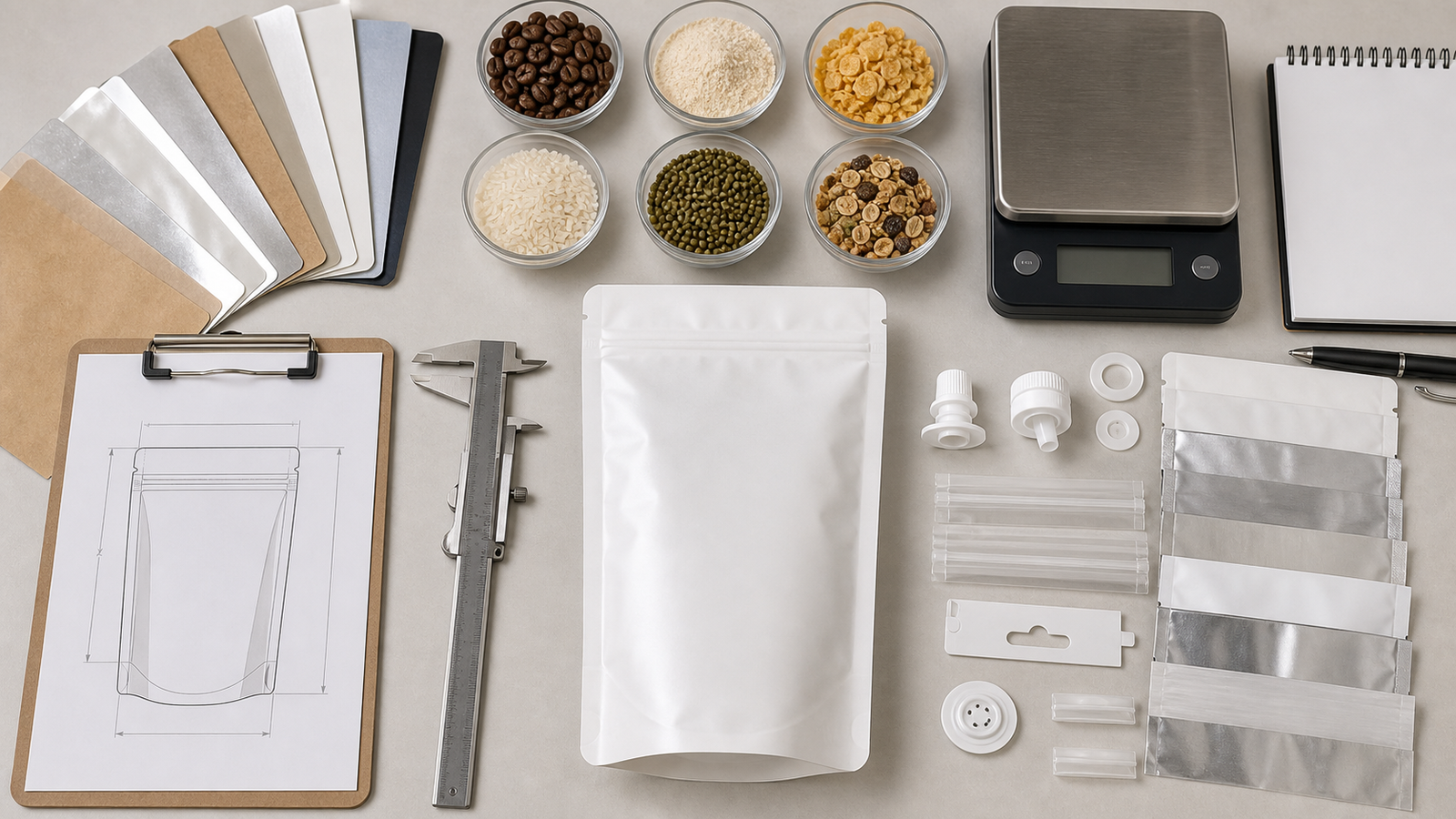
Start with the product and filling process, not only the desired appearance. A supplier needs to know what the pouch will contain, how much space the product occupies, what can affect its quality, and how the package will be produced and distributed.
Include these RFQ inputs:
- Product: Product category, physical form, relevant ingredients, particle characteristics, and sensitivity to oxygen, moisture, or light.
- Fill: Target net weight, occupied volume, bulk density, fill temperature, settling behavior, gas release, and required headspace.
- Shelf life: Target duration, storage environment, target markets, and expected heat, humidity, or handling conditions.
- Pouch dimensions: Width, height, gusset depth, bottom style, and desired filled presentation. State whether the dimensions are fixed or open to recommendation.
- Material and barrier: Preferred laminate if known, total thickness, sealant needs, and required OTR or WVTR with units and test conditions.
- Features: Zipper, tear notch, hang hole, window, valve, spout, or other fitment, including required positions.
- Filling method: Premade pouch or rollstock, machine make and model when available, output target, sealing setup, and changeover limits.
- Printing: Artwork status, number of designs, finish, variable information, and usable print area.
- Commercial scope: Sample or trial needs, estimated order quantity, delivery location, timing, and quotation format.
- End-of-life objective: Target-market disposal or recycling expectations. Relevant packaging recycling guidance8 should be reviewed for each intended market rather than inferred from appearance.
Identify unknown items instead of filling gaps with assumptions. Ask for representative samples and a written approval path covering structure, dimensions, filling compatibility, seals, features, and finished-pouch performance.
For a pouch recommendation, sample, or quotation, send your product type, fill weight and volume, proposed pouch size, material or barrier need, required features, order quantity, artwork status, and premade or rollstock filling method.
References
-
Which Flexible Packaging Format Fits Your Product Best? - YLTPACK - A 3-side seal pouch is sealed on three sides and normally lies flat. A stand-up pouch includes a bottom gusset that allows it to stand upright ... ↩
-
Oxygen Transmission Rate | OTR Testing Services - Measurlabs - Oxygen transmission rate (OTR) is used to analyze the quality of packaging materials. Measurlabs offers accredited OTR testing at transparent prices. ↩
-
How Do You Convert Product Density To Bag Fill Weight? - Bag Fill Weight = Bag Usable Volume × Bulk Density. Step 1: Calculate the bag's theoretical volume from dimensions. Example. Step 2: Apply a ... ↩
-
One-way degassing valves - MTPak Coffee - One-way degassing valves are an essential component for specialty coffee bags. They keep coffee bags airtight by relieving the pressure of escaped gases. ↩
-
Water vapor transmission rate measurement for moisture barriers ... - Here we demonstrate a spatially resolved imaging methodology for water vapor transmission rate (WVTR) testing that relies on quantified infrared ... ↩
-
Can I run a horizontally made Stand-up Pouch or Bag on ... - Like a VFFS machine, a horizontal form fill and seal machine takes a roll of film, forms it into a package, fills the package, and seals it - ... ↩
-
Seal Strength vs Seal Integrity Testing: ASTM F88, D3078, and What ... - FlexPak package leak detectors support four ASTM-compliant seal integrity testing methods, covering flexible and rigid packaging across food, pharmaceutical, ... ↩
-
Boost sustainability with mono-material packaging | Business - Shell - Mono-material designs can improve recycling results as there's no need to separate product and packaging parts to make them compatible with recycling ... ↩