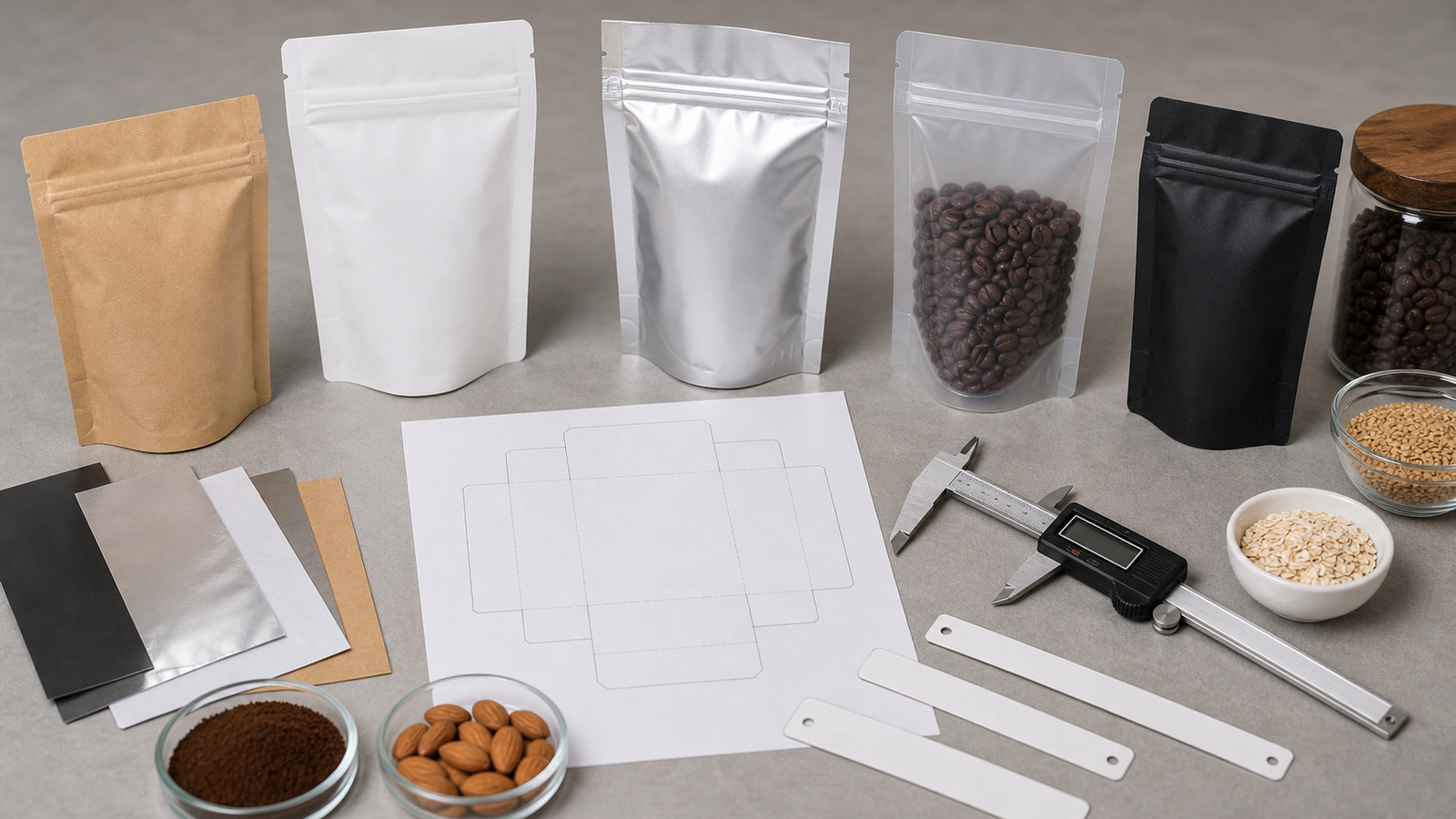
Measuring a custom pouch is easy only when the pouch is still empty. Once the product is filled, sealed, packed, and handled, the flat size on a drawing becomes only one part of the specification. A workable size also depends on gusset behavior, seal land, headspace, closure position, product volume, material stiffness, and the filling method.
I usually treat pouch size as a filled-pack decision. The goal is not just to hold the product. The pouch must seal cleanly, stand or lie as intended, fit the shipper, and run through the planned process without avoidable stress.
What Does Width x Height + Gusset Mean for a Custom Pouch?
Width x Height + Gusset states the outside flat size of a custom pouch. Width runs left to right, height runs bottom to top, and gusset describes the expansion fold. The unit must be clear because inches and millimeters change tooling, artwork, filling setup, and carton fit.
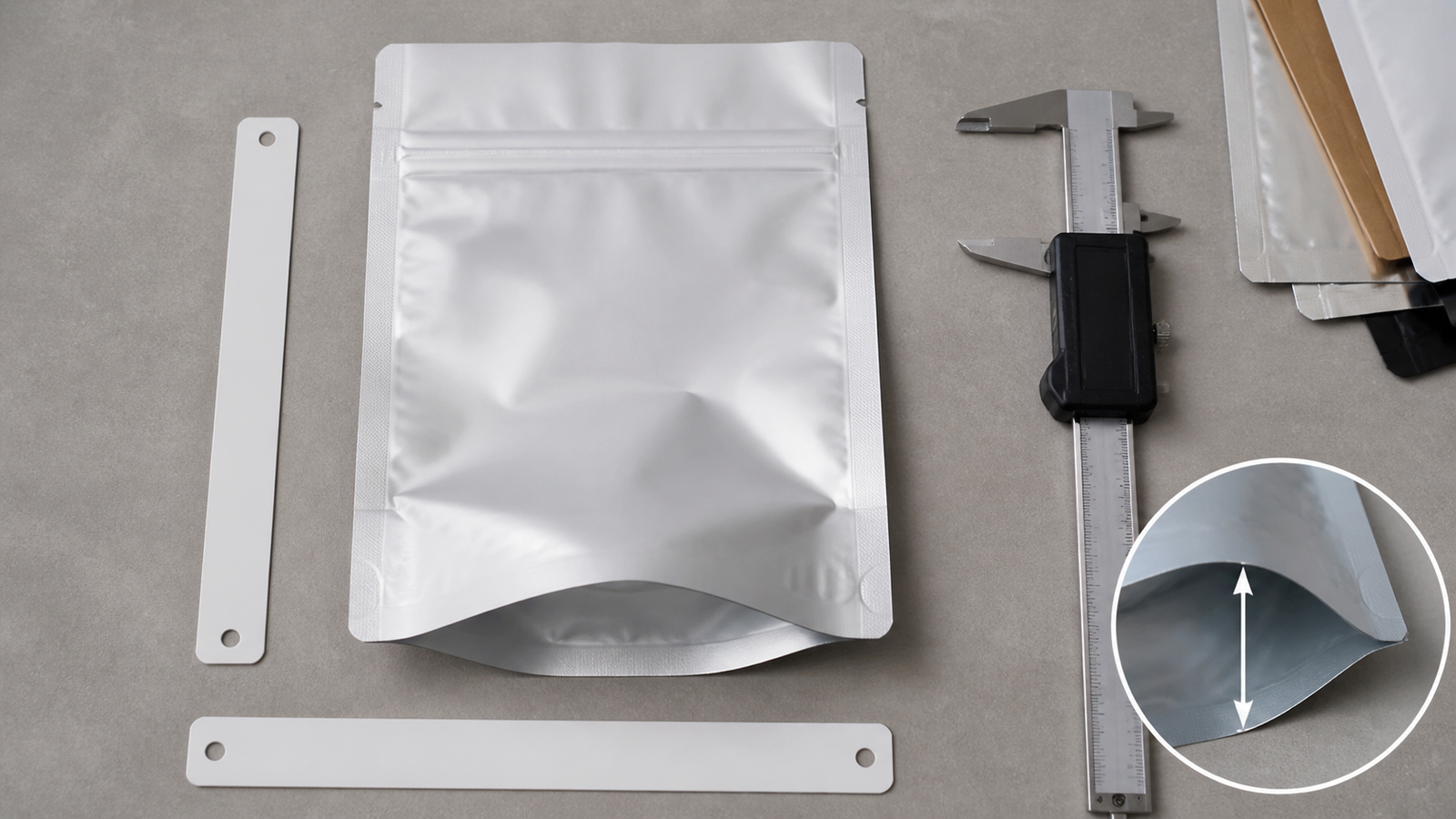
Start with the outside measurement1, not an estimate of internal capacity. Width is measured flat from the left outside edge to the right outside edge. Height is measured from the bottom reference edge to the top edge. Gusset is the folded section that opens when the pouch is filled.
For a stand-up pouch, the common notation is Width x Height + Bottom Gusset. A size such as 140 mm x 210 mm + 70 mm bottom gusset describes the flat front panel width, the full outside height, and the folded base depth. It does not automatically describe filled depth, usable fill space, or the final standing footprint.
A clear size line should name:
- Unit: mm or inches
- Measurement type: outside flat size
- Pouch family: stand-up, lay-flat, side-gusseted, or flat-bottom
- Gusset type: bottom gusset or side gusset
- Reference edge: top edge, bottom fold, bottom seal, or formed base
- Tolerance: allowed converting variation
A common mistake is sending only “6 x 9 pouch” with no unit, gusset, or format. That can describe several different packs. It also leaves open whether the number refers to outside dimensions, artwork area, or usable product chamber.
Material should sit beside the size line. A thicker PET/PE laminate, metallized structure, or mono-material PE structure can fold, stand, and seal differently at the same nominal dimensions. Size, seal width, zipper position, laminate thickness, and fill method should be reviewed together.
How Much Fillable Space Is Lost Inside a Listed Pouch Size?
The listed pouch size is always larger than the space available for product. Seals, zippers, tear notches, hang holes, spouts, valves, rounded corners, and gusset forming areas reduce usable fill space, so capacity should not be estimated from outside height alone.

Outside size is a converting dimension. Fillable space is what remains after functional features take their share of the pouch. The difference is especially important on small pouches, zipper pouches, spouted pouches, and stand-up formats with a deep bottom gusset.
The top zone usually loses space first. A zipper needs room below the top seal. A tear notch needs a clean position. A hang hole can consume header space. If the pouch has a spout, the fitment area, weld zone, and cap clearance must be protected.
The side and bottom zones matter as well. Side seals are not product space. Bottom gusset folds create standing volume, but they are not a simple rectangular chamber. Rounded corners and shaped cuts can also reduce the area available for product or labeling.
Which features reduce fillable space most often?
For dry goods, the main deductions are usually zipper position, top seal height, side seals, and bottom gusset formation. For liquids and pastes, the larger concerns are seal width, spout weld area, headspace, and product movement during handling. For valve pouches, the valve area also needs a protected zone.
Example: A pouch listed as 160 mm high may have much less practical fill height after the top seal, tear notch, zipper track, and clean headspace are deducted. The outside number is still correct. It is just not the product chamber height.
For barrier-sensitive products, do not reduce seal width casually2 to gain a few millimeters. Seal geometry and sealing window matter. A PET/AL/PE or PET/metallized film/PE laminate may offer strong barrier properties, but the pouch still needs enough clean seal area to function as a finished package.
Should Pouch Size Be Based on Volume Instead of Net Weight?
Pouch size should be based on product volume and fill behavior, not net weight alone. Dense, fluffy, irregular, and aerated products can weigh the same but occupy different space, changing width, height, gusset depth, headspace, and final filled posture.
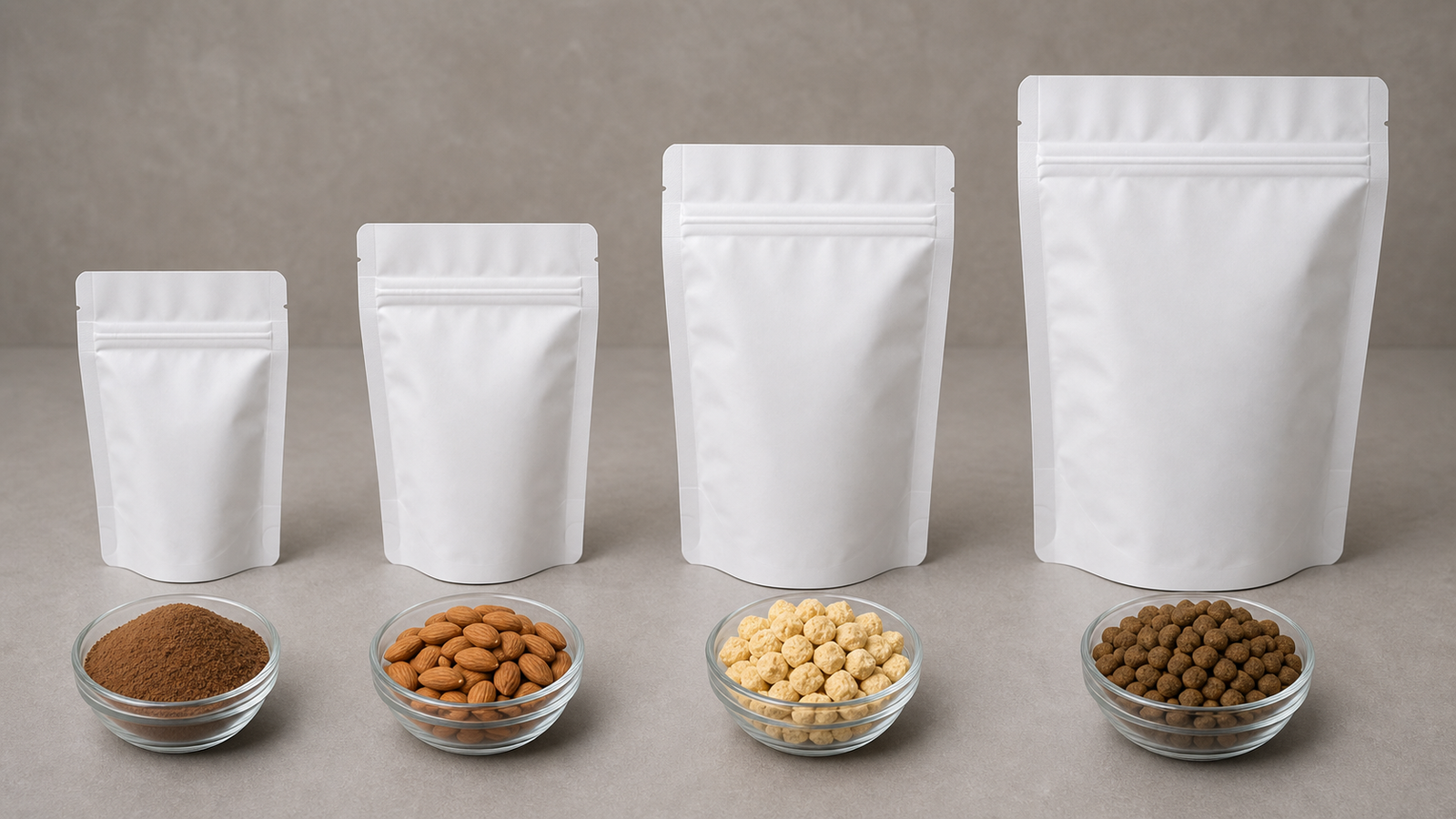
Net weight supports labeling and planning, but it does not define pouch size. The missing factor is bulk density: how much space a product occupies at a given weight. Settling behavior, particle shape, trapped air, and vibration during transport can all change the fill level.
Scenario: Equal net weight, different pouch volume. This is a teaching example, not a real project record. A 100 g dense powder may settle into a compact fill height. A 100 g irregular snack may need more internal volume because the pieces trap air and cannot pack tightly. A 100 g freeze-dried product may need still more room because it is light, fragile, and bulky.
| Product at same net weight | Sizing risk | Specification response |
|---|---|---|
| Dense powder | Low volume, dust near seal | Confirm clean headspace and seal-bar access |
| Nuts or candy | Moderate volume, uneven settling | Test actual product at target fill amount |
| Freeze-dried snack | High volume, crush sensitivity | Increase chamber volume and review compression |
| Pet treat | Irregular shape, variable packing | Check filled depth, posture, and carton fit |
Volume also changes material choices. A bulky product may need more stiffness so the pouch does not slump. Sharp-edged dry goods may need puncture resistance, a thicker sealant layer, or a PA-containing laminate. Powder may need a wider sealing window because dust can interfere with seal formation.
When barrier matters, request OTR and WVTR data with units and test conditions. OTR describes oxygen transmission rate3, while WVTR describes water vapor transmission rate. Those values should be tied to shelf-life target, storage conditions, and whether the data applies to the film structure or the finished pouch.
How Should Different Pouch Formats Be Measured?
Different pouch formats need different measurement rules. A lay-flat pouch may only need width and height, while stand-up, side-gusseted, and flat-bottom formats require gusset or depth measurements that affect capacity, filled shape, shelf posture, and carton fit.

Choose the pouch family before locking the size. A stand-up pouch, side-gusseted bag, flat-bottom pouch, and lay-flat pouch may all hold product, but they form different shapes after filling. Measuring them as if they were the same format creates weak specifications.
| Pouch format | Required size fields | Specification consequence |
|---|---|---|
| Lay-flat pouch | Width x height | Simple chamber; no gusset volume to calculate |
| Stand-up pouch | Width x height + bottom gusset | Bottom fold controls base formation and shelf posture |
| Side-gusseted bag | Width x height + side gusset | Side folds add depth while the front face stays narrower |
| Flat-bottom pouch | Width, height, side gusset, bottom width, filled depth | Box-like shape affects panels, display, and carton packing |
A stand-up pouch is usually specified by flat width, outside height, and bottom gusset. The bottom gusset is not the same as final filled depth; it is the folded material that opens into the base. A side-gusseted format adds depth through left and right folds. A flat-bottom pouch often needs more fields because the filled pack behaves more like a flexible box.
Should the gusset be measured folded or opened?
Use the supplier’s measurement convention4 consistently and write it into the specification. Some teams describe folded gusset depth, while others discuss opened depth or filled footprint. Those are not interchangeable.
The measurement method should also match converting and filling. Premade pouch filling, VFFS, HFFS, and manual filling can require different tolerances around opening width, film stiffness, seal land, and gusset deployment.
When Do Flat Size and Filled Dimensions Both Need Approval?
Flat size and filled dimensions both need approval when the pouch must stand, stack, hang, fit a tray, fit a carton, or present a specific shelf profile. Flat dimensions guide converting and artwork, while filled dimensions prove real pack behavior.
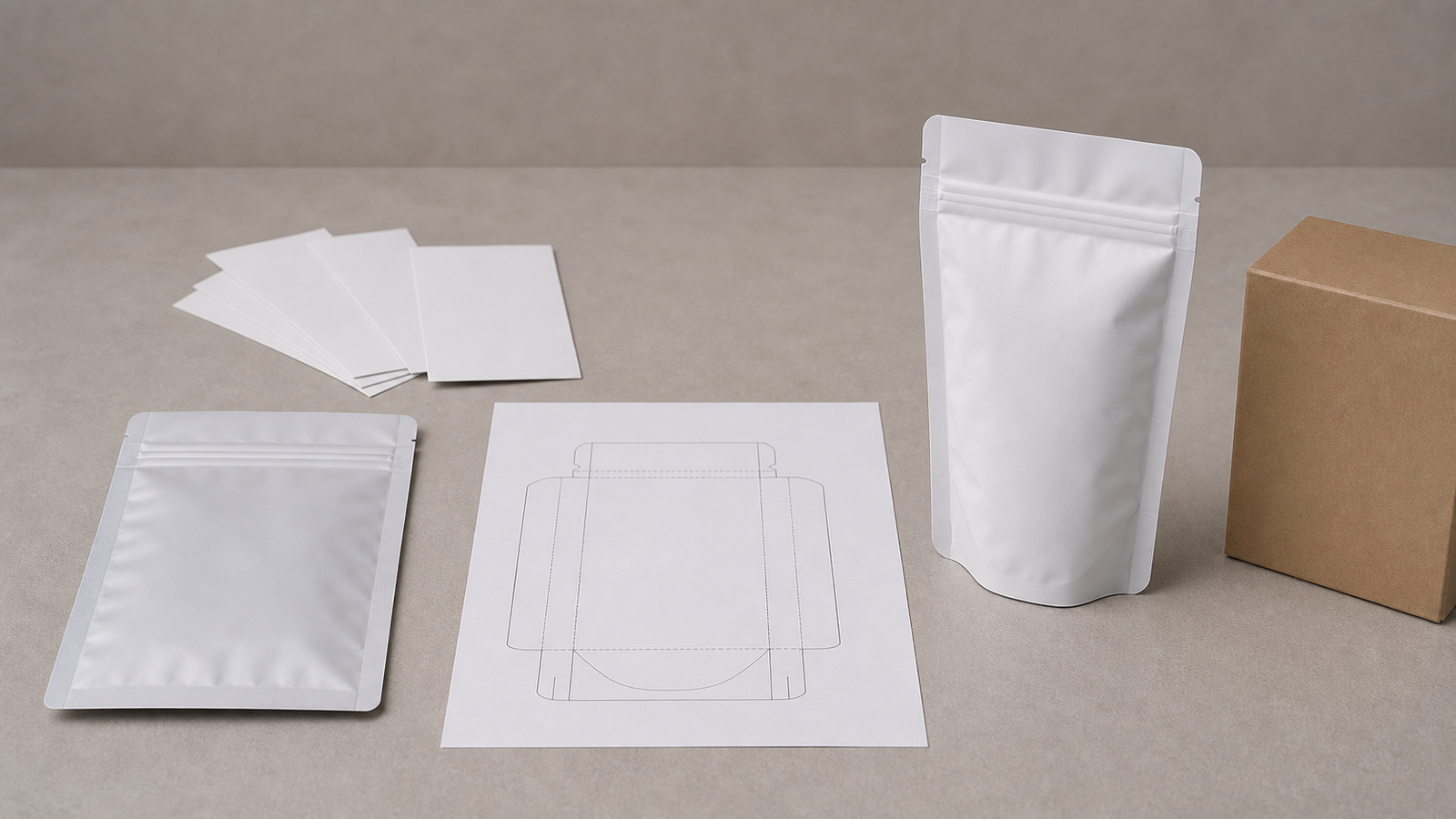
Flat size belongs to tooling, dielines, printing, and converting. It tells the converter how wide and tall the pouch is before filling. It also helps define print layout, seal zones, zipper placement, tear notch position, and cutting tolerance.
Filled dimensions answer a different question: what shape does the pouch take after product is inside? That matters for shelf display, carton packing, e-commerce handling, retail trays, and warehouse storage. A pouch that looks correct when empty can become too deep, unstable, or visually underfilled after packing.
Flat size is mainly reviewed for:
- Dieline setup
- Print registration
- Seal placement
- Zipper or spout position
- Film yield and converting tolerance
- Artwork safe zones
Filled dimensions are mainly reviewed for:
- Standing posture
- Filled width, depth, and height
- Carton count and orientation
- Tray fit
- Compression risk
- Headspace after settling
If the pouch uses a high-barrier laminate such as PET/AL/PE, filled shape matters because sharp folds, compression, and repeated flexing can affect finished-pack integrity. If a mono-material PE or PP structure5 is being considered for recyclability goals, filled posture and stiffness need extra review because it may behave differently from mixed-material laminates.
The practical rule is simple: approve flat dimensions for manufacturing, then approve filled dimensions for use. If the pouch must stand, stack, hang, or fit a defined shipper, both sets of numbers belong in the specification.
How Much Clearance Is Needed for Rigid or Shaped Contents?
Rigid or shaped contents need clearance beyond the measured object size. The pouch must allow for header space, zipper bulk, seal land, side seals, bottom structure, gusset shaping, insertion movement, and handling stress without forcing the product into the seals.

A rigid item cannot be sized into a pouch the same way loose powder or granules can. The product has fixed edges, corners, thickness, or shape. If the pouch is too close to the product dimensions, insertion becomes difficult and the item may press into seal areas during handling.
Clearance depends on product shape and pouch format. A flat sachet containing a rigid card may need side and top clearance so the card does not stress the seals. A pouch for a shaped accessory may need more width for insertion angle. A stand-up pouch holding a rigid refill component may need bottom and side clearance so the product does not distort the gusset.
The clearance review should include:
- Header area above the product
- Top seal and zipper space
- Side seal land
- Bottom seal or bottom gusset area
- Tear notch position
- Hang hole reinforcement area
- Any shaped corner or radius
A flat product measuring 120 mm wide x 180 mm high does not belong in a 120 mm x 180 mm pouch. Those are outside pouch dimensions, not internal clearance dimensions. The product would collide with side seals and the top functional area. Start with object dimensions, then add clearance, closure space, and seal width.
For heavier or sharper shaped items, structure matters. A thin PE film may not provide enough stiffness or puncture resistance. PET/PE, PET/PA/PE, or a thicker PE structure may be more suitable depending on edge profile, sealing method, and distribution route.
How Much Headspace Is Needed to Protect the Seal Area?
Headspace must keep product below the zipper, top seal, side seals, spout weld, valve area, and tear notch during filling and sealing. A pouch can have enough volume but still fail if powder, crumbs, oil, sauce, or dust contaminates the seal area.
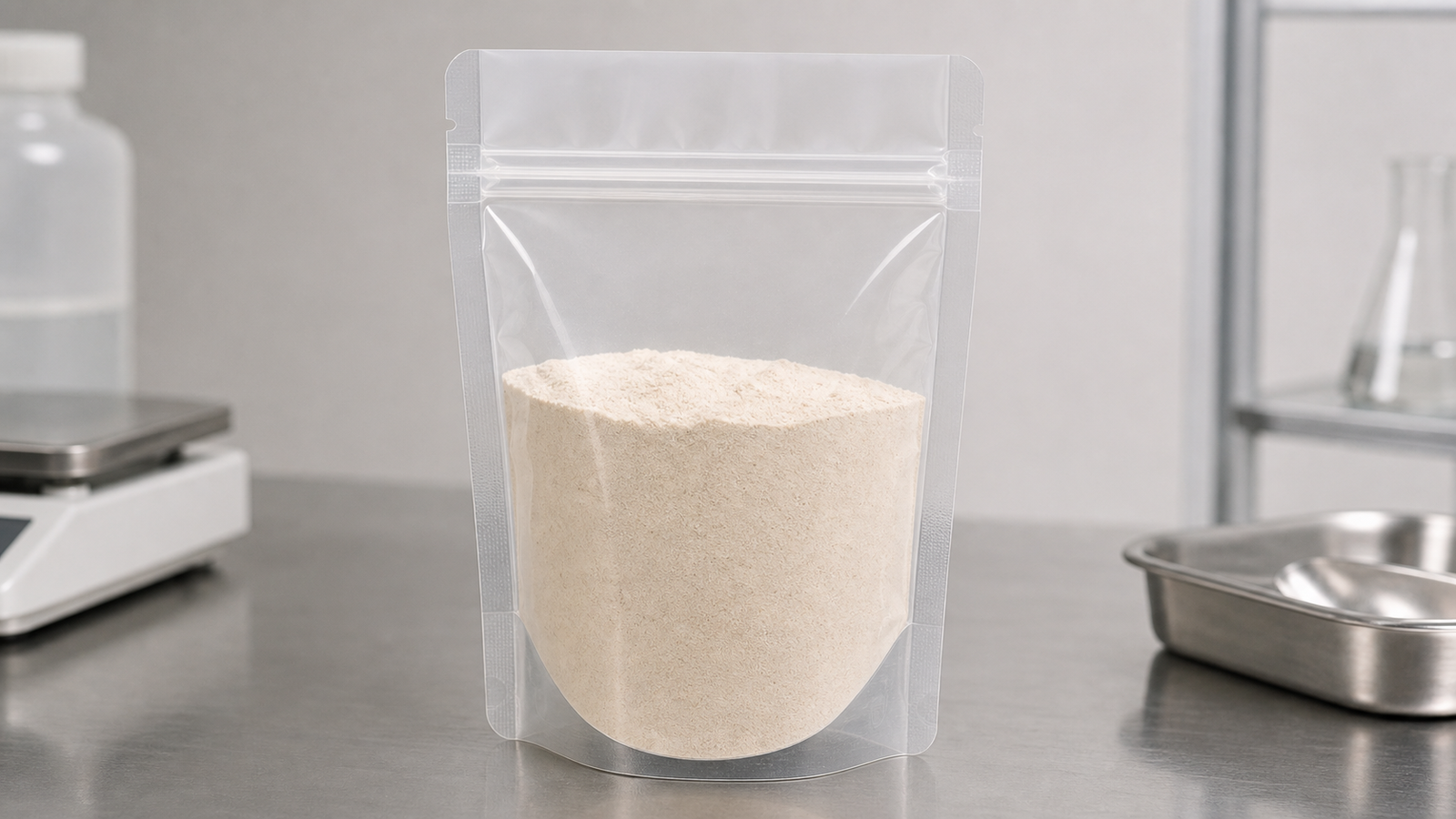
Headspace is the clean space between the product fill level and the zone that must seal, close, or function. It is not wasted space. It protects seal formation, zipper function, tear performance, and sometimes the product itself during distribution.
The required headspace depends on product behavior. Fine powders can dust upward during filling. Crumbs can sit across the seal land. Sauces and oils can smear into the top seal area. Liquids and pastes can move under compression or during drops. Light snacks can settle after vibration, changing the fill level after the pouch has already been sealed.
What happens when headspace is too tight?
The pouch may look efficient on paper but become unreliable in production. Seal jaws may close over product residue. The zipper may be difficult to reclose. The tear notch may sit too close to product. A spout weld or valve area may be crowded. The top seal may look acceptable but contain a weak area where residue interrupted sealing.
Seal width and sealing window should be discussed with size. The sealing window is the practical range of jaw temperature, pressure, and dwell time6 that forms an acceptable seal. A laminate with a PE or PP sealant layer still needs clean contact and enough flat seal land. Product contamination narrows the practical range of jaw temperature, pressure, and dwell time.
For powders, oily products, and liquids, size review should include actual fill behavior. A bench fill can show dust, splash, or product climb. An automated fill trial can show whether turbulence reaches the seal area at planned line speed.
What Fill Test Should Be Done Before Locking the Pouch Size?
Before locking a custom pouch size, fill a close reference pouch or sample kit with the actual product. Check headspace, seal access, filled posture, shelf appearance, zipper clearance, gusset opening, and carton fit before spending time on tooling or final artwork.
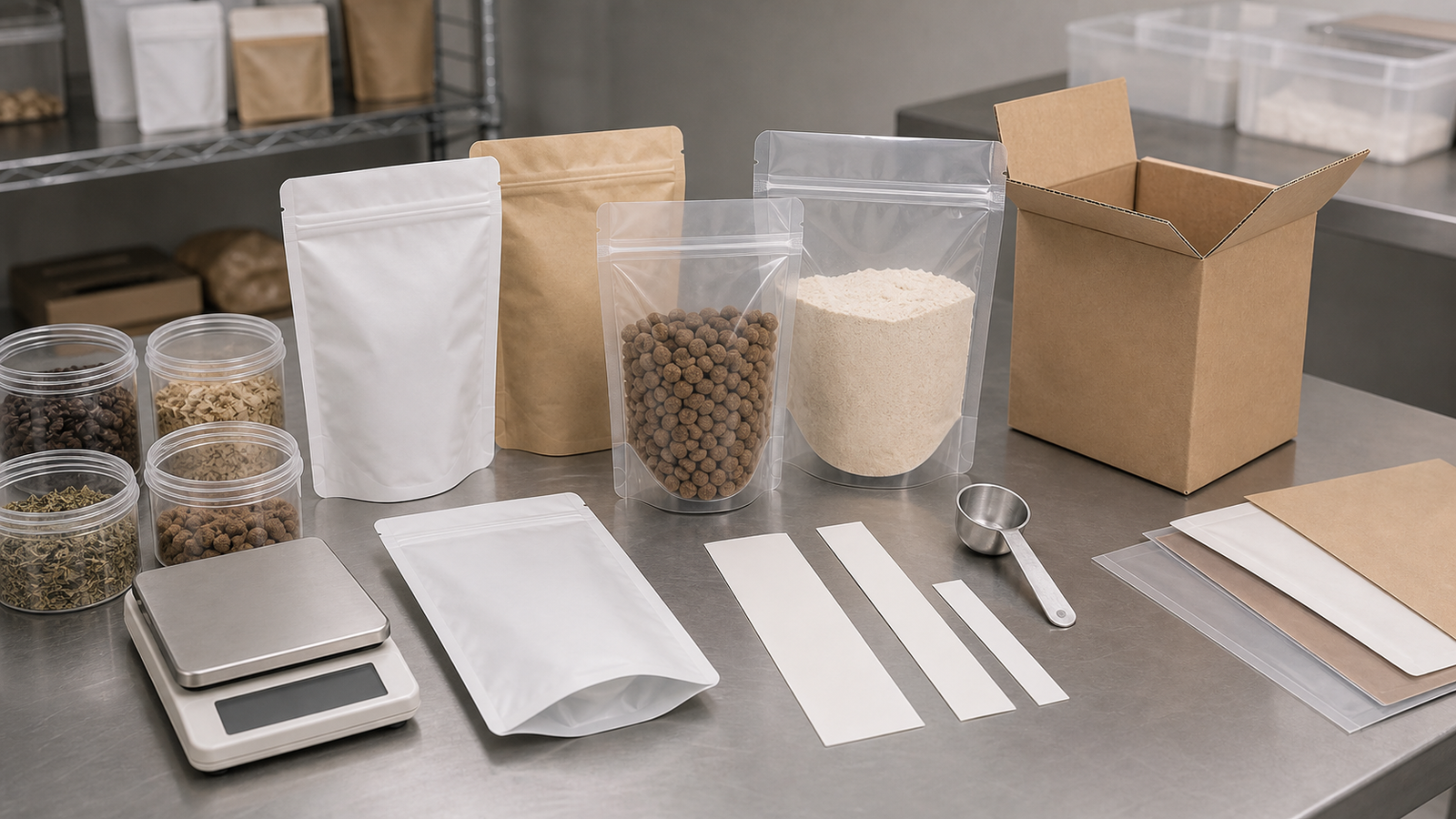
A first fill test does not need to be elaborate. It needs to be honest. Use the actual product, the target fill amount, and a pouch close enough to the proposed format to show whether the direction is sound. Empty samples are useful, but they cannot prove volume, posture, or seal access.
A practical early fill test should cover:
- Select a reference pouch in the intended family.
- Fill the actual product to the target weight or volume.
- Tap, settle, or handle it in a way that reflects normal packing behavior.
- Check remaining headspace and clean seal area.
- Close the zipper or top seal if applicable.
- Stand, lay, or hang the pouch as intended.
- Place filled samples into the intended carton or tray.
- Record flat size, filled dimensions, product level, and visible stress points.
A powder pouch may look oversized before settling, then become acceptable after vibration. An irregular snack may look acceptable at first, then show poor carton fit because the pieces create uneven filled depth. Both observations are useful.
For later approval, the test should become more controlled. Filled samples can be reviewed for seal strength, leakage, drop behavior, compression, and shelf-life needs where relevant. If the product is oxygen- or moisture-sensitive, the fill test should not replace barrier review. Ask for OTR and WVTR values with test method, temperature, relative humidity, and whether the data applies to film only or finished pouch7.
The first fill test is meant to prevent the wrong custom size from becoming a formal drawing too early.
Will the Measured Pouch Size Work on the Filling Line?
A measured pouch size must match the filling line, not only the product volume. Check pouch opening, nozzle or funnel clearance, gripper hold, seal-bar access, zipper position, gusset behavior, and flat material area before approving a size for automated production.
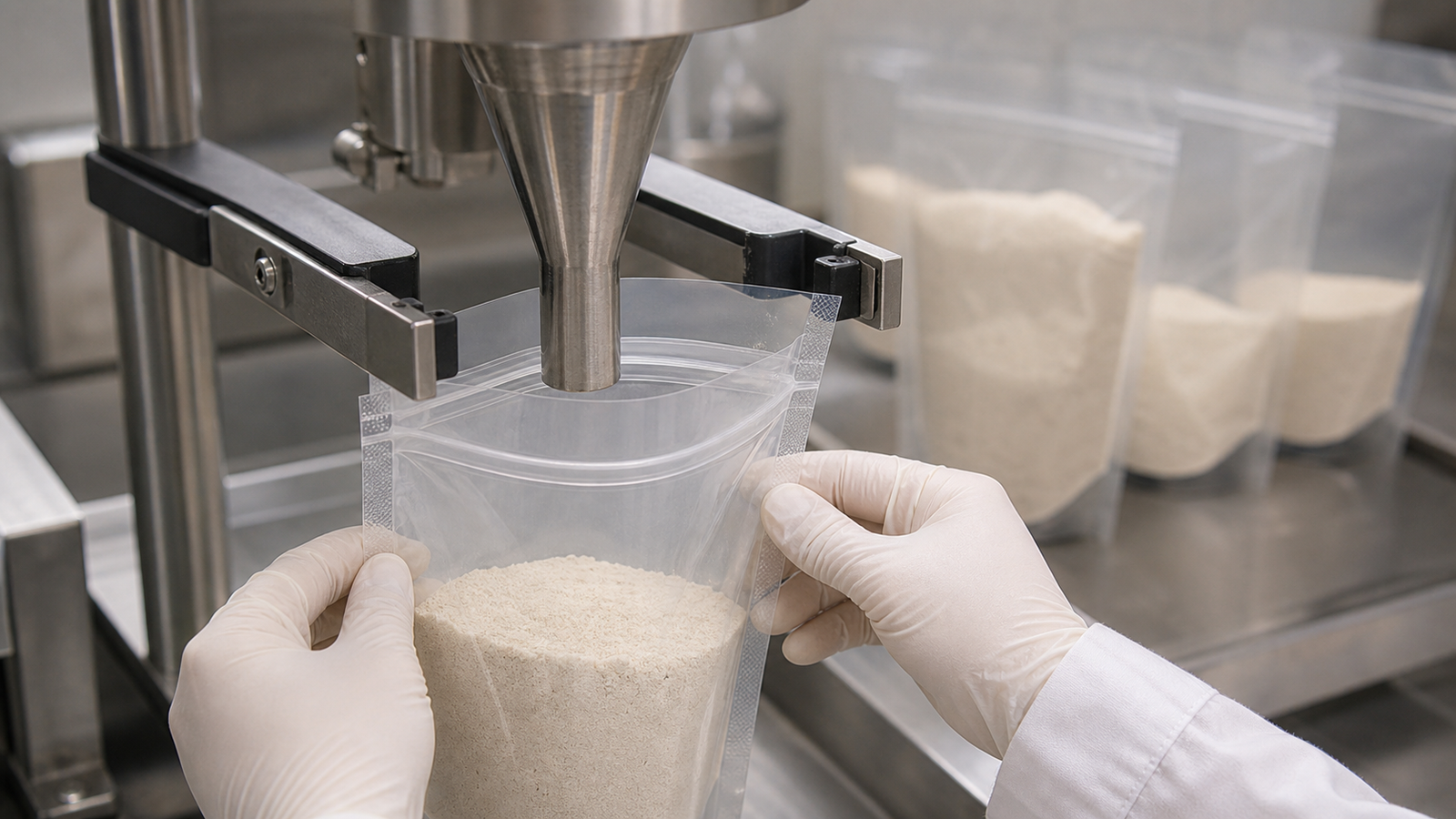
Hand filling can hide problems that automated equipment will expose. A pouch may hold the product and look acceptable on a bench, yet still fail to open consistently, sit correctly in grippers, or present enough flat material for the seal bar.
Define the filling method early. Premade pouch filling, VFFS, HFFS, sachet lines, spouted pouch filling, and manual filling each create different size constraints. Premade pouch lines often need enough top opening for grippers and filling nozzles. VFFS may need film stiffness, coefficient of friction8, and seal behavior that suits forming and pulling. Spouted formats may need fitment pitch, cap handling, and torque control.
Before final approval, check:
- Does the opening fit the funnel, nozzle, or fill tube?
- Can grippers hold the pouch without hitting zipper bulk or weak zones?
- Is there enough flat top area for the seal bar?
- Does the bottom gusset open consistently during filling?
- Does the zipper sit below the top seal with enough clearance?
- Does product residue reach the seal area at planned speed?
- Does the material seal within the available temperature, pressure, and dwell range?
Why does material matter to filling compatibility?
Thickness, stiffness, slip, and sealant type all affect line behavior. A PET/PE laminate may feed differently from a mono-material PE pouch. A stiffer structure may stand better but resist opening. A softer structure may open easily but lose posture. Size, film structure, and filling method should be reviewed together.
For automated projects, a hand-filled sample should only guide direction. Confirm the measured size on the intended or comparable filling process before releasing the format.
How Should Size Be Checked Against Seals, Drops, and Cartons?
Final pouch size approval should include filled-pack checks, not only a capacity review. Seal stress, zipper strain, gusset shape, pouch posture, drop behavior, compression, and carton packing can reveal whether the measured size works under realistic handling conditions.

A pouch can pass the first fill test and still be the wrong size for distribution. The filled pack has to survive handling, packing, transport, and storage conditions that an empty pouch cannot show. Size affects how force moves through the seals, gusset, zipper, and panels.
The usual weak points are the top seal, zipper ends, side seals, bottom gusset corners, spout weld area if present, and sharp product contact points. When the pouch is too tight, these zones carry more stress. When it is too loose, product can shift, the pouch can slump, and carton packing can become inefficient.
For final size checks, review:
- Seal stress after filling
- Zipper strain and zipper-end seal land
- Gusset opening and base posture
- Filled thickness and carton count
- Drop behavior in likely orientations
- Compression from stacking or e-commerce handling
- Product movement inside the pouch
- Appearance after settling or vibration
Scenario: A pouch for a heavy paste may appear properly filled on the bench. During a drop, the paste can surge toward the top seal or side seal and create stress that was not obvious in static review. That does not automatically mean the material is wrong; the size, headspace, seal width, and distribution pack may all need review.
Where distribution risk is high, align checks with recognized methods instead of informal handling alone. Seal strength can be reviewed using ASTM-style seal testing9 where suitable. Leak checks, gross-leak checks, and transport simulations can support fit-for-use decisions. The exact plan should match product risk, market route, and pouch format.
What Size Details Belong in a Custom Pouch RFQ?
A custom pouch RFQ should include measurable size facts, not only a target capacity. Include outside width, height, pouch format, gusset type, gusset method, tolerance, closure positions, seal width, headspace, fill amount, bulk density, filled dimensions, filling method, and distribution conditions.

A useful RFQ gives a supplier enough information to recommend a workable pouch instead of copying a rough size. Size information should connect to product behavior, material structure, filling process, and handling route.
Use this checklist before sending a sizing request:
- Outside width and outside height
- Unit of measurement
- Pouch family: lay-flat, stand-up, side-gusseted, flat-bottom, spouted, or shaped
- Gusset type and gusset measurement method
- Required size tolerance
- Target fill weight or fill volume
- Product bulk density if known
- Product form: powder, granule, snack, liquid, paste, rigid item, or mixed contents
- Required headspace above fill level
- Target filled width, height, and depth if carton fit matters
- Seal width and seal geometry expectations
- Zipper position, tear notch position, spout position, valve position, or hang hole position
- Filling method: manual, premade pouch line, VFFS, HFFS, spout filling, or another process
- Fill temperature if relevant
- Material preference or required laminate discussion
- Barrier needs, including OTR and WVTR data request if shelf life depends on oxygen or moisture control
- Print area, dieline, and artwork status
- Order quantity and SKU count
- Distribution route, carton packing, compression risk, and drop risk
If sustainability goals apply, include them early. Mono-material PE or PP structures, recycled-content options10, paper-based laminates, compostable films, and foil laminates do not behave the same way in stiffness, barrier, heat resistance, machinability, or sealing window.
The RFQ should also state what needs approval: empty sample dimensions, filled dimensions, shelf posture, seal performance, carton fit, filling trial, or full fit-for-use review. A request based only on “250 g stand-up pouch” is usually too thin for responsible sizing.
For a size recommendation, sample direction, or quotation, send the product type, fill weight or volume, current pouch size if any, material or barrier need, closure features, order quantity, filling method, target filled dimensions, and distribution route.
References
-
How to Measure a Stand Up Pouch - We measure both height and opening by measuring the outside dimensions (OD). The third dimension of measurement is the bottom gusset. ↩
-
Observing the effect of pressure and temperature on the seal ... - Folding geometry and the design of a flexible package cause pressure differences along sealing region during heat sealing. These differences might be one of ... ↩
-
Oxygen Transmission Rate and Barrier Flexible Packaging - An OTR is useful for comparing options under identical ambient conditions. ... Standardized test conditions of 73°F and 0% RH, for example, might ... ↩
-
How to Measure and Select Gusset Size for Stable Stand Up Pouches - Bottom gusset depth should be roughly 40% to 60% of the pouch width. · It should also be at least one third of the total height. ↩
-
Guide to Mono-Material Flexible Packaging Structures - Glenroy, Inc. - Learn how mono-material flexible packaging simplifies recycling, matches foil-level barrier, and hits sustainability goals. ↩
-
Heat sealing evaluation and runnability issues of flexible paper ... - The seal temperature used ranged from 100 to 130 °C with a dwell time of 1 to 100000 s, to characterize the development of interfacial strength. Mueller et al. ↩
-
Food Packaging Barrier Testing Explained: OTR vs WVTR - Barrier testing measures how well your packaging keeps oxygen (OTR: Oxygen Transmission Rate) and moisture (WVTR: Water Vapor Transmission Rate) ... ↩
-
The Impact of Film Coefficient of Friction on VFFS Machine Operations - Films with a high COF can slow down production as the machine compensates for the increased resistance. Conversely, films with a lower, more ... ↩
-
ASTM F88 - Plastic Film Seal Strength - The Universal Grip Company - ASTM F88 outlines the standard method for measuring the seal strength of flexible barrier materials, typically used in packaging applications. ↩
-
Top Flexible Packaging Materials Used in Food and Retail Industries - Although the traditional multilayer laminates are good in barrier performance, they tend to mix materials which cannot be easily recycled. Single-material ... ↩