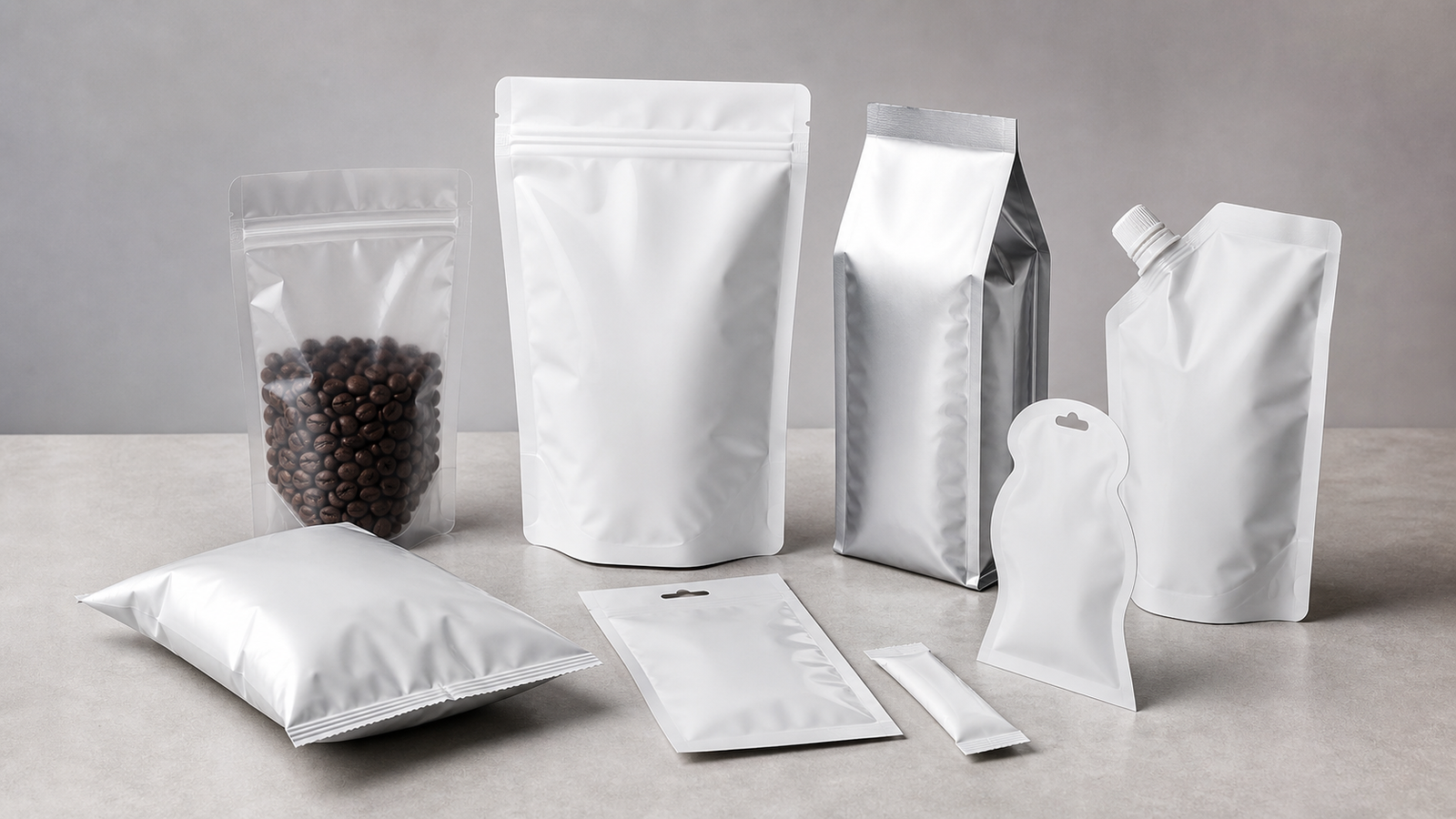
Pouch packaging looks simple from the outside, but buyers often run into trouble when every flexible format is treated as the same bag. A stand-up pouch, pillow pouch, flat pouch, sachet, side-gusset bag, box pouch, shaped pouch, and spouted pouch can all use flexible film, yet they solve different packaging problems.
I would not start with the shape that looks best in a catalog. I would first define how the pouch must stand, fill, seal, ship, store, open, and sell. Once those points are clear, material structure, filling equipment, closure choice, and quotation details become much easier to compare.
Which pouch type should buyers compare first?
Buyers should compare pouch type by function before comparing price or artwork. The first decision is whether the pack must stand, lie flat, run on rollstock equipment, hold liquid, show strong shelf presence, or serve as a compact sample or unit-dose format.
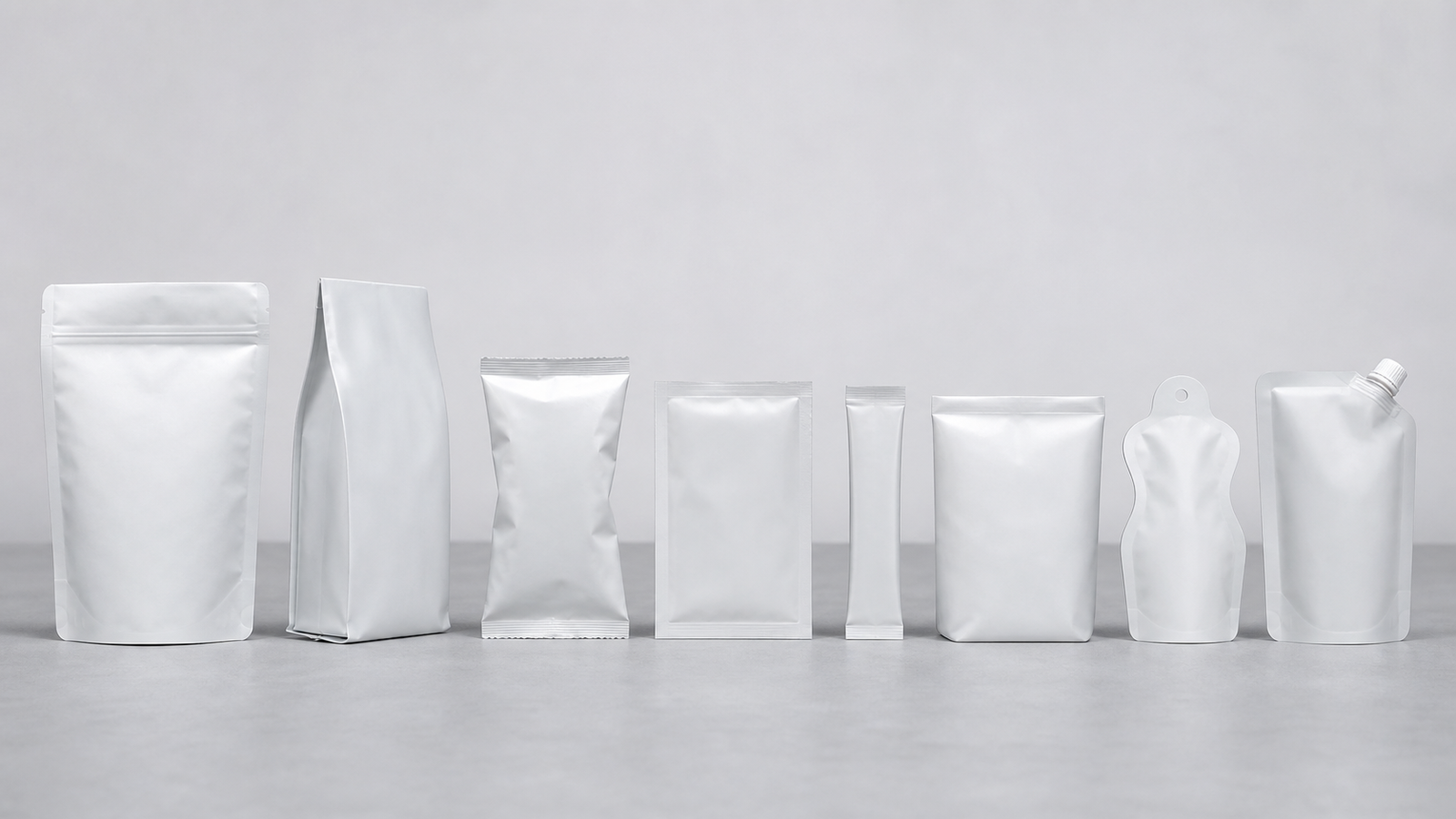
Supplier catalogs often mix pouch names by structure, application, and filling method. That is why two quotations can both say custom pouch but describe very different packs. One may be a premade stand-up pouch with a zipper. Another may be rollstock for pillow packs on a vertical form-fill-seal line1. A third may be a 4-side-seal sachet for liquid samples.
A practical first comparison is not “which pouch looks better?” It is “what job must this pouch do?”
| Pouch type | Strong buyer fit | First specification question |
|---|---|---|
| Stand-up pouch | Retail display and front-panel branding | Does it need a bottom gusset, zipper, valve, or spout? |
| Side-gusset pouch | More fill volume with a narrower front face | Can the filler handle gusset expansion and final pack thickness? |
| Pillow pouch | High-speed packing and lower unit cost | Is rollstock VFFS or flow-wrap equipment available? |
| 3-side-seal pouch | Flat samples, compact refills, or small portions | Will it be premade or formed and sealed inline? |
| 4-side-seal sachet | Uniform samples, liquids, sauces, or unit doses | Can the seal area stay clean during filling? |
| Flat-bottom pouch | Stable shelf block and extra printable panels | Does the shelf value justify the added converting complexity? |
| Shaped pouch | Visual differentiation for selected SKUs | Is the order volume high enough for custom tooling? |
| Spouted pouch | Controlled dispensing for liquids or pastes | What spout, cap, headspace, and leak checks are required? |
A 250 g dry snack pouch, a 250 ml sauce pouch, and a 250 g coffee pouch may share a similar finished size, but they should not be specified the same way. The dry snack may need stiffness and moisture barrier. The sauce may need stronger seals and headspace control. The coffee may need aroma protection and possibly a valve. Define the pouch family first, then ask suppliers to recommend the film structure and converting details.
When should a buyer choose a stand-up, flat-bottom, or side-gusset pouch?
Choose between stand-up, flat-bottom, and side-gusset pouches by shelf footprint, usable volume, branding area, pack-out efficiency, and filling equipment. They may all stand or expand, but they do not behave the same in cartons, on shelves, or on packing lines.
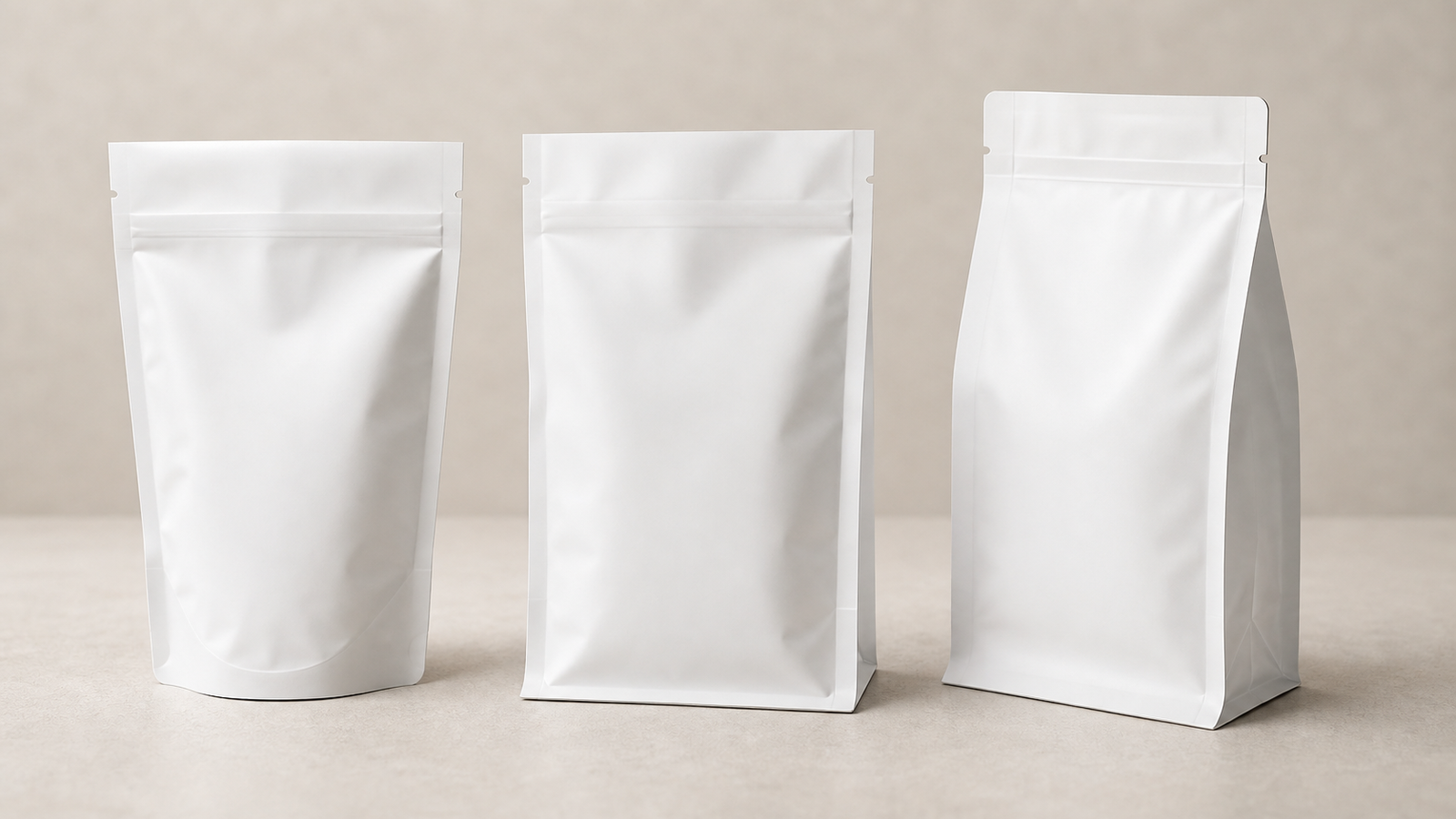
A bottom-gusset stand-up pouch is often the most versatile retail option. It gives the pack a clear front panel, can support zipper or tear-notch features, and suits many snacks, powders, dried foods, pet treats, and refill products. It is usually a sensible starting point when the buyer needs shelf presence without a carton-like footprint.
Flat-bottom pouches, also called box pouches, block-bottom pouches, or 8-side-seal pouches in some markets, create a more rectangular base. They can improve shelf blocking and provide extra printable side panels. Buyers often consider them for premium coffee, specialty snacks, pet food, nutraceuticals, and products where the package needs to look more structured. The tradeoff is higher converting complexity and tighter filling-line fit.
Side-gusset pouches expand through the side panels. They suit higher-capacity dry products such as coffee, grains, powders, and some bulk goods, especially when the front face should stay narrower.
| Format | Best buyer reason to use it | Watch point before approval |
|---|---|---|
| Bottom-gusset stand-up pouch | Broad retail use, moderate fill weights, strong front panel | Check base stability after filling and zipper clearance if used |
| Flat-bottom pouch | Premium shelf block, more printable panels, squared pack shape | Confirm feeding, opening, and sealing capability with the filler |
| Side-gusset pouch | Higher volume dry goods with a narrower front face | Confirm product settling, final pack thickness, and carton fit |
I would also check case pack efficiency2 early. A pouch that looks stronger on shelf may reduce how many units fit in a shipper. A more rectangular flat-bottom design can sometimes improve pack-out, but only if the filled pouch holds its shape consistently.
Are flat pouches, pillow pouches, and sachets used for the same projects?
Flat pouches, pillow pouches, and sachets are not the same choice. They can all be compact formats, but the better option depends on filling speed, seal layout, product state, dosing accuracy, line type, cost per pack, and opening behavior.

Pillow pouches are usually chosen when speed and cost per pack matter. They commonly use a fin seal or lap seal3 on the back, plus top and bottom cross seals. Many snack, confectionery, bakery, powder, and small-portion products use pillow packs because VFFS or horizontal flow-wrap equipment can run them efficiently from rollstock.
Three-side-seal flat pouches behave more like flat envelopes. They can suit powders, solid samples, small portions, wipes, accessories, or compact refill packs. Depending on the project, they may be supplied premade or formed and sealed on suitable equipment.
Four-side-seal sachets have sealed edges around the perimeter. They can create a uniform small pack and are often considered for sauces, cosmetic samples, medical-adjacent samples, unit-dose products, and small liquid or semi-liquid portions.
Before treating these formats as interchangeable, check:
- Whether the pack is premade or formed from rollstock.
- Whether the available line is VFFS, HFFS, flow-wrap, sachet, stick-pack, or manual filling.
- Whether powder dust, liquid splash, or product residue can contaminate the seal area.
- Whether the consumer needs controlled tearing, easy opening, or a precise dose.
- Whether the pack must hang, lie flat, or be sold inside a carton.
Example: A powder sample may work in a 3-side-seal pouch if dust can be controlled before sealing. A sauce sample may be safer in a 4-side-seal sachet because the perimeter seal and pack shape better support small liquid portions. The visible size may look similar, but the seal risk is different.
When do gussets solve a pouch volume problem?
Gussets help when the buyer needs more fill volume without making the pouch too wide, unstable, or inefficient in cartons. Side gussets, bottom gussets, and flat-bottom construction each expand the pack differently, so the right choice depends on shelf footprint and filling method.
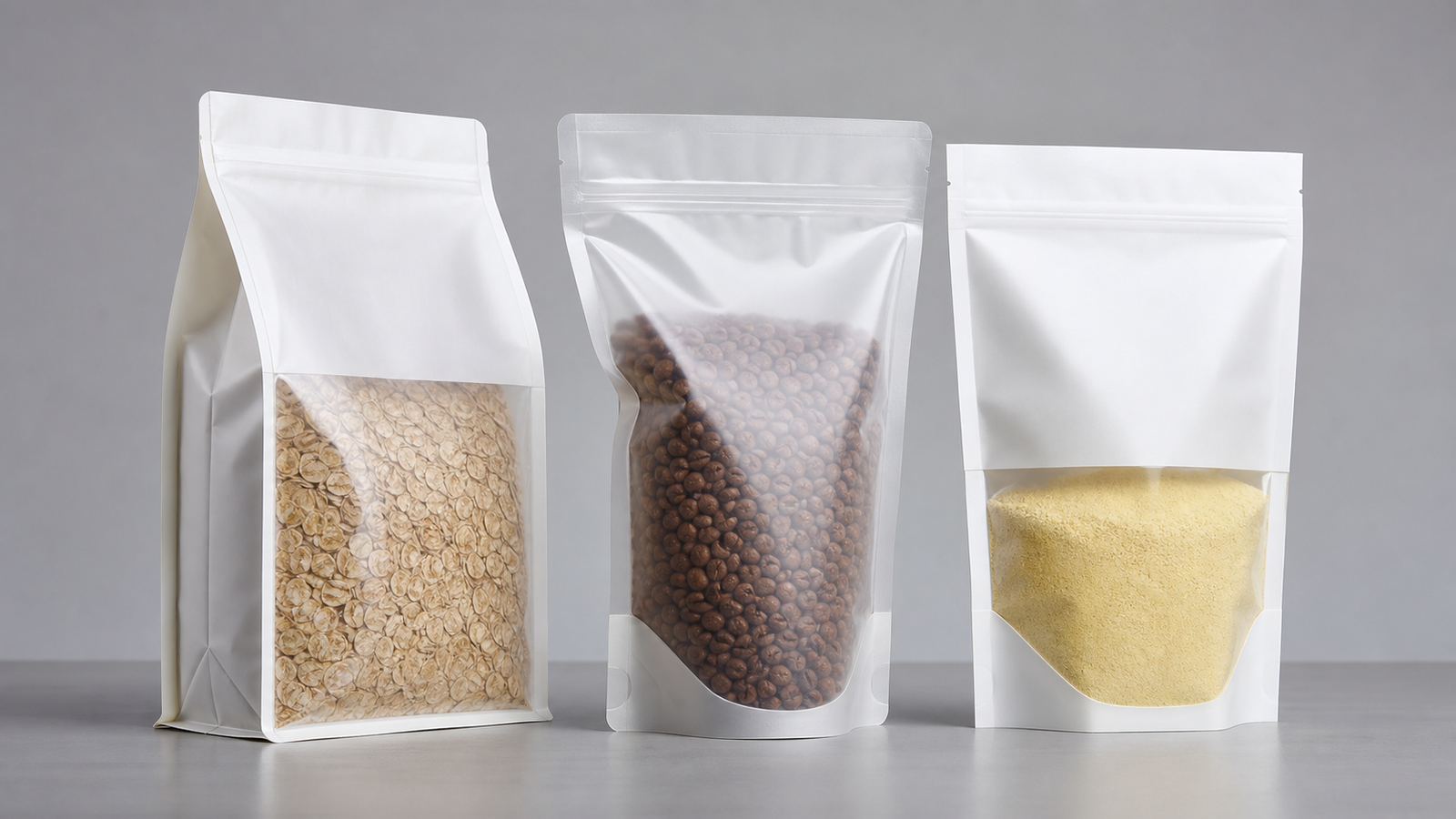
A gusset is a folded film area4 that opens as the pouch is filled. It lets the pack hold more product than a simple flat pouch with similar front dimensions. The useful question is where the added volume should go: downward into a standing base, sideways into pack depth, or into a more rectangular box-like footprint.
Bottom gussets unfold at the base. They help a pouch stand upright and create a larger front display panel, which is why Doy-style stand-up pouches are common for snacks, powders, pet treats, dried fruit, and refill products.
Side gussets expand from the left and right panels. They can make the package thicker while keeping the front face narrower. That can work well for coffee, grains, powders, and dry bulk products, but it changes how the pouch fills, settles, seals, and fits into cartons.
Flat-bottom construction goes further by creating a more rectangular base and additional side panels. It can improve shelf blocking and branding space, but it may need a more specialized premade pouch supply and compatible feeding equipment.
Scenario: A buyer wants to increase fill weight while keeping the same shelf width. A wider stand-up pouch may hurt shelf fit. A side-gusset pouch may add depth instead. A flat-bottom pouch may improve shelf stability and carton stacking. The right answer depends on retail layout, product settling, and co-packer capability.
| Gusset choice | Practical advantage | Approval check |
|---|---|---|
| Bottom gusset | Better standing and front display | Filled base stability and seal shape |
| Side gusset | More capacity without much added width | Product settling, final pack thickness, and carton fit |
| Flat bottom | Squarer footprint and extra information panels | Equipment fit, cost, lead time, and minimum quantity |
When is a shaped pouch worth the added cost?
A shaped pouch is worth considering when the custom outline can improve shelf recognition, campaign value, or product identity enough to justify added tooling, registration control, lead time, scrap risk, and minimum order quantity. It should not be the default for price-sensitive SKUs.
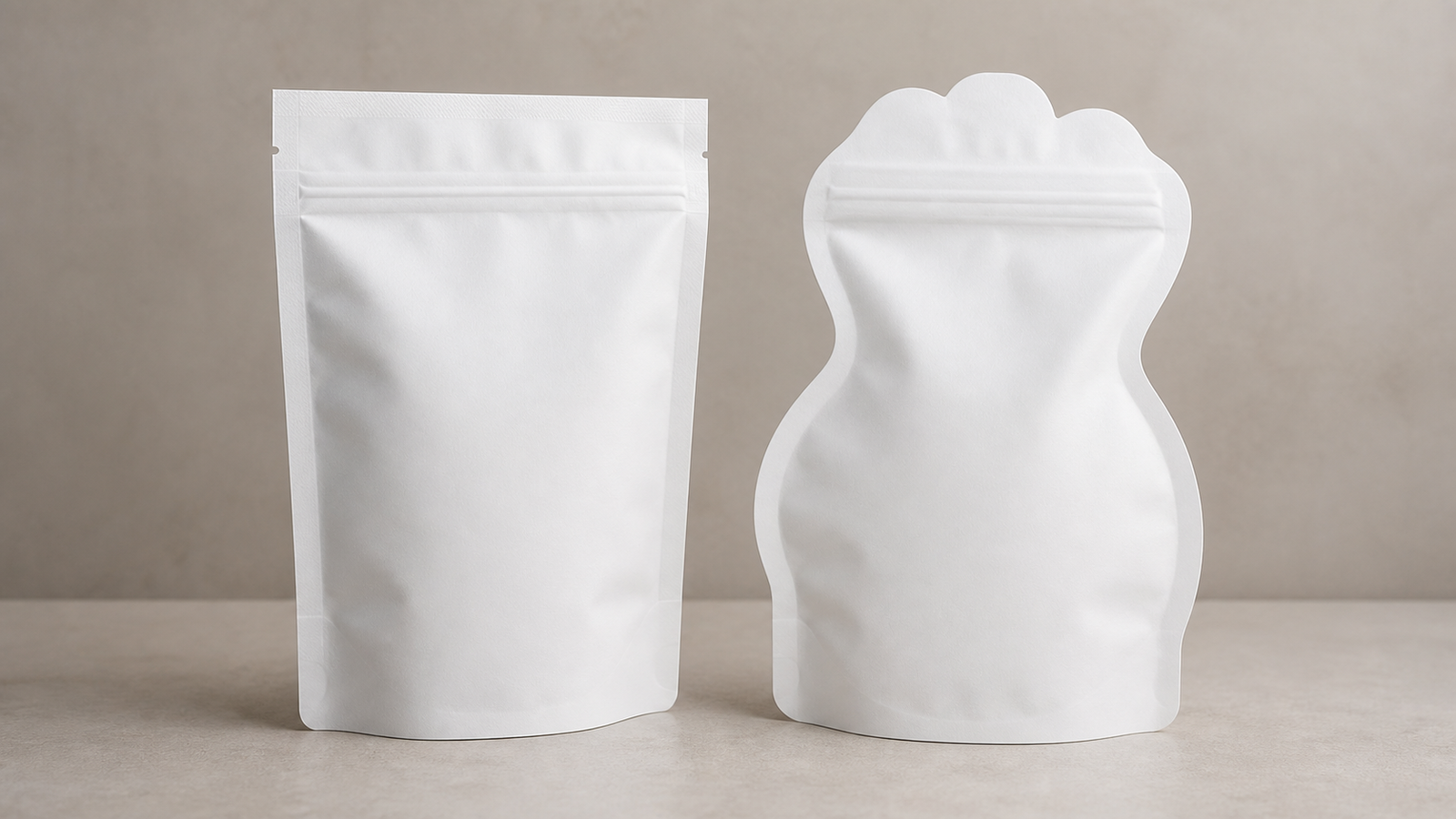
Shaped or die-cut pouches usually start from a conventional stand-up or flat pouch structure. The custom outline is then added for stronger shelf differentiation. This can be useful for children’s products, promotional packs, hero SKUs, seasonal launches, and products where the package silhouette supports a clear commercial idea.
The cost is not only the cutting die. A shaped pouch can require tighter print registration5, more careful die-cutting, more layout planning, and sometimes more film waste. If the shape narrows a seal area, creates a sharp corner, or places stress near a fitment, it can affect pouch strength or filling behavior. For liquids, pastes, and heavy products, I would be cautious about any shape change near seals, spouts, or high-flex areas.
Use shaped pouches only when the added complexity has a clear job:
- Stronger shelf recognition for a hero SKU.
- Seasonal or promotional packaging with enough order volume.
- Children’s or gift-oriented products where shape supports the buying decision.
- Product identity that cannot be communicated well through print alone.
Do not use them just because the first mockup looks more interesting. Commodity refills, price-led packs, and frequent low-volume SKU changes usually need simpler formats. A standard stand-up or flat pouch with better artwork may give the buyer more value than a difficult custom outline.
The decision should include tooling cost, minimum order quantity, lead time, scrap risk, usable print area, and filling-line handling. If the co-packer cannot feed the shaped pouch smoothly, the shelf idea can become a production problem.
Why is pouch material thickness not enough to compare offers?
Thickness alone does not tell a buyer whether a pouch will protect the product, seal reliably, run on equipment, or survive distribution. Material comparison should include barrier, sealant layer, stiffness, puncture resistance, machinability, product compatibility, shelf-life target, and sealing window.
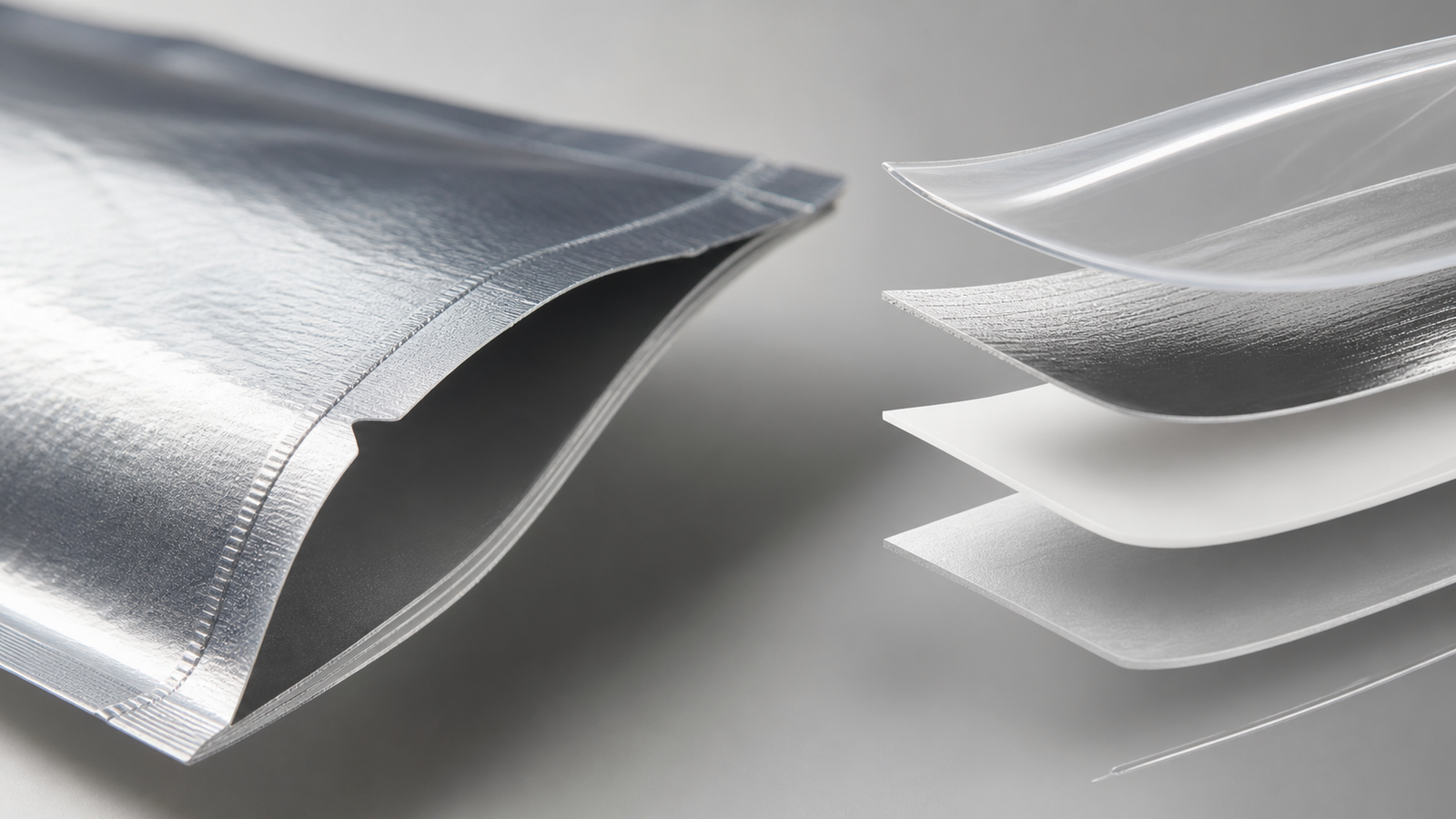
A pouch film is a structure, not just a thickness number. Two pouches can both be 100 microns and perform differently because the layers are different. PET/PE, PET/AL/PE, PET/metallized film/PE, PET/PA/PE, EVOH-based high-barrier structures, and mono-material PE or PP structures can all differ in barrier, stiffness, sealing behavior, puncture resistance, heat resistance, and recyclability discussions.
OTR and WVTR are useful terms when they are tied to test conditions. Oxygen transmission rate6 measures oxygen passage through a film. Water vapor transmission rate measures moisture vapor passage. The number is not very useful unless the temperature, humidity, and test method are stated. A vague claim like high barrier does not tell the buyer whether the structure fits coffee aroma, snack crispness, powder stability, or sauce shelf life.
| Material factor | Practical consequence | Buyer question |
|---|---|---|
| Oxygen barrier | Affects oxidation, aroma retention, and shelf life | What OTR comparison or target is being used, and under what conditions? |
| Moisture barrier | Protects crispness, powder flow, and dry product stability | What WVTR condition is relevant to the storage route? |
| Sealant layer | Controls heat sealing and product-contact surface | What sealing window works on the actual line? |
| Stiffness | Affects shelf appearance, pouch opening, and machine handling | Will it stand, feed, and open reliably after filling? |
| Puncture resistance | Matters for sharp, granular, or heavy products | Is a toughness layer such as PA needed? |
| Product compatibility | Protects against oil, acid, fragrance, or chemical interaction | Has the structure been checked against the formula? |
A sealing window is the range of temperature, pressure, and dwell time where the seal forms properly without burning, shrinking, or leaking. I would ask suppliers to explain the proposed laminate or mono-material structure in relation to product, line type, shelf-life target, and distribution conditions before comparing price.
Can the selected pouch run on the co-packer’s equipment?
The selected pouch must match the co-packer’s actual forming, feeding, filling, sealing, coding, and inspection setup. A pouch that looks correct in artwork can still fail commercially if the line cannot run it efficiently or consistently at production speed.
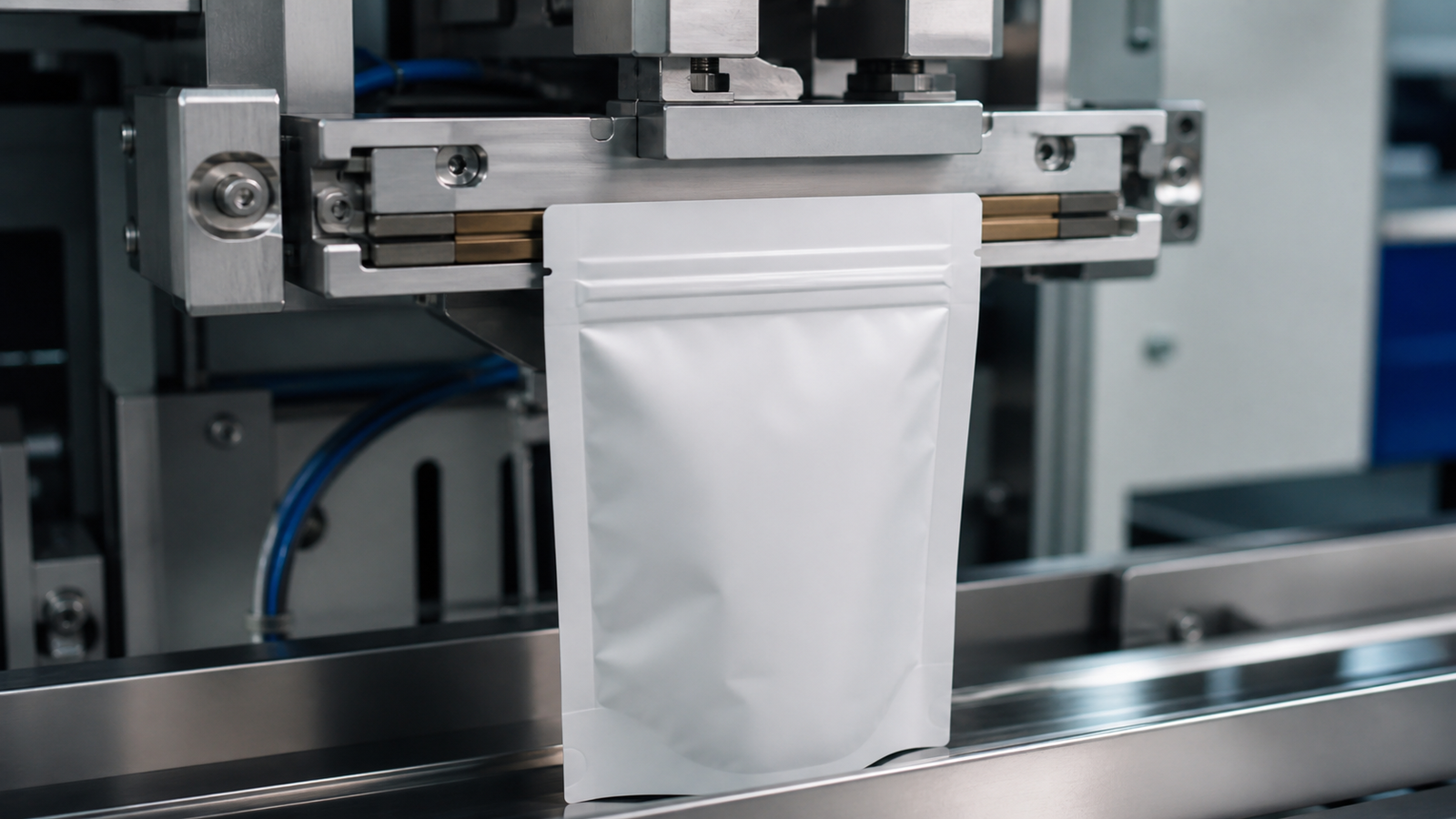
Filling compatibility should be checked before artwork and tooling decisions. Premade stand-up pouches, flat-bottom pouches, side-gusset bags, pillow packs, and sachets may need different equipment. A pillow pouch is often made from rollstock on VFFS or horizontal flow-wrap equipment. A 3-side-seal pouch may be supplied premade for separate filling, while a sachet may be produced on HFFS, stick-pack, or dedicated sachet equipment.
Scenario: A brand approves a flat-bottom pouch because it looks premium in a mockup. Later, the co-packer confirms the existing line only handles standard premade stand-up pouches within a narrower opening range. The project then faces a pouch redesign, slower manual handling, new tooling, or a different co-packer. That is not a material failure. It is an approval sequence failure.
Use this approval checklist before locking the pouch:
- Confirm whether the pouch is premade or formed from rollstock.
- Confirm the filling line type: VFFS, HFFS, flow-wrap, sachet, stick-pack, rotary premade pouch, inline premade pouch, or manual.
- Confirm pouch width, height, gusset depth, opening width, zipper clearance, and tolerance range.
- Confirm whether the line can open, feed, and hold the pouch shape.
- Confirm fill path, fill temperature, dust or splash control, and product settling behavior.
- Confirm seal temperature range7, pressure, dwell time, and cooling needs.
- Confirm coding position, inspection method, leak check, and reject handling.
- Confirm target line speed and expected waste during startup.
I would get written feedback from the filler or equipment supplier before final artwork approval. It is cheaper to change a pouch drawing than to fix a format the line cannot run.
How should pouch type change for dry goods, liquids, powders, coffee, and samples?
Pouch type should change with product state, handling behavior, dispensing needs, leak risk, and shelf-life requirements. Dry snacks, coffee, powders, liquids, gels, samples, and refills may use similar fill weights but still require different formats, materials, closures, and testing.
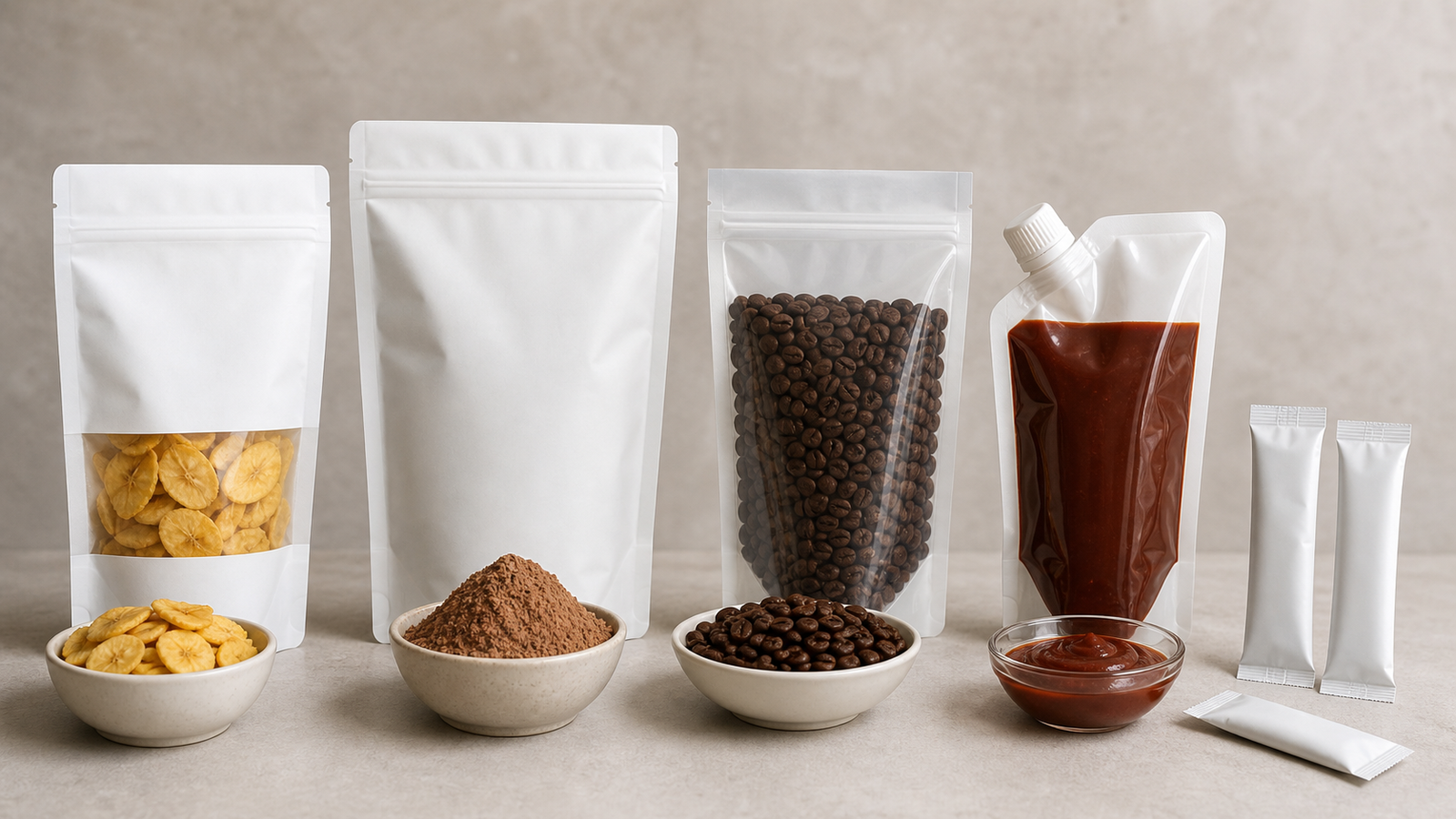
A pouch should be selected around what the product does inside the package. Dry snacks may need moisture barrier, stiffness, seal integrity, and shelf appearance. Coffee may need aroma protection and, in some cases, a degassing valve8. Powders can create dust in the seal area, settle after filling, or require attention to static and flow. Liquids and gels may need stronger seals, spouts, fitments, controlled headspace, and leak testing.
A nominal fill weight can mislead buyers. A 100 g powder pouch and a 100 g sauce pouch do not create the same packaging risk. Powder can contaminate the seal and weaken closure reliability. Sauce can stress seals during drops, compression, temperature change, or pressure change. Coffee may need better oxygen and aroma protection. A cosmetic sample may need a clean tear and controlled dose.
| Product type | Common pouch direction | Early specification risk |
|---|---|---|
| Dry snacks | Stand-up pouch, pillow pouch, or flat pouch | Moisture barrier, stiffness, seal integrity, shelf display |
| Coffee | Side-gusset, flat-bottom, or stand-up pouch | Aroma barrier, oxygen exposure, valve need, pack-out |
| Powders | Stand-up, side-gusset, sachet, or stick-style format | Dust in seal area, settling, static, filling accuracy |
| Liquids and sauces | Spouted pouch, 4-side-seal sachet, or liquid-use flat pouch | Seal strength, headspace, fill temperature, leak testing |
| Cosmetic samples | 3-side or 4-side-seal sachet | Tear behavior, dose control, product compatibility |
| Refills | Stand-up, spouted, or flat pouch | Dispensing, closure, puncture resistance, transport route |
I would compare format, material structure, closure, filling method, leak risk, shelf display, and distribution route together. Treating all flexible pouches as one category is where many avoidable specification problems begin.
What information should a buyer include in a pouch RFQ?
A good pouch RFQ should describe the product, pouch family, fill size, material priorities, filling method, closure needs, print requirements, order quantity, and distribution conditions. This lets suppliers quote a workable package instead of guessing at a generic pouch price.

The weakest RFQ is a short request for a pouch price with size and quantity only. That may produce a number, but it does not prove the quoted structure fits the product, filling line, shelf-life target, closure requirement, or distribution route.
A buyer-ready RFQ should include:
- Product type and product form: snack, powder, coffee, liquid, gel, paste, refill, sample, or other.
- Fill weight or fill volume, plus target pouch size if already known.
- Target pouch family: stand-up, flat-bottom, side-gusset, pillow, 3-side-seal, 4-side-seal sachet, shaped, or spouted.
- Filling method: premade pouch filling, VFFS, HFFS, flow-wrap, sachet machine, stick-pack machine, or manual.
- Line details if known: opening range, seal temperature limits, fill temperature, line speed, and coding position.
- Material or barrier need9: oxygen barrier, moisture barrier, aroma retention, grease resistance, light protection, puncture resistance, mono-material preference, or other sustainability request.
- Closure features: zipper, tear notch, valve, spout, cap, tamper evidence, or no closure.
- Print requirements: number of SKUs, print method preference, finish, window, matte or gloss, and barcode area.
- Quantity details: trial quantity, first order quantity, target launch date, and repeat forecast.
- Distribution route: e-commerce, retail shelf, export shipment, cold chain, hot fill, or rough handling risk.
For liquid pouches, add viscosity, fill temperature, headspace expectation, spout or fitment details, cap type, and leak-test expectations. For powders, add dust concerns and settling behavior. For coffee, state whether a degassing valve is needed.
We recommend sending product photos, current pack photos, target shelf-life information, and filling-line notes when available. Those details help suppliers recommend a workable structure instead of simply matching the lowest visible thickness.
For a pouch recommendation, sample direction, or quotation, send the product type, fill weight or volume, target pouch size, preferred pouch family, material or barrier need, zipper, valve, spout or other features, filling method, order quantity, and distribution route. Those inputs let us narrow the structure before quoting.
References
-
How Vertical Form Fill Seal (VFFS) Packaging Machines Work - VFFS machines integrate three core tasks—forming bags from rollstock film, filling with product, and sealing the pouch—into a single automated ... ↩
-
What Is A Case Pack? - Custom Packaging Products - A case pack is the standard number of units that are packed together in one shipping case (usually a master carton) and treated as one sellable/ ... ↩
-
Fin Seal versus Lap Seal: What's the difference? - Flexible Pouches - While fin seal creates a vertical seal along the back of the package, lap seal forms a horizontal seal along the side. ↩
-
What Is A Gusset On A Pouch? A Complete Guide for Buyers - A gusset is the area that is folded along the sides or bottom of the pouch. When the package is opened, the gusset expands, thereby increasing ... ↩
-
Diecut Shaped Pouches | #1 Best Custom Shaped Pouches - CarePac - The Die-Cut Shaped Pouch. Custom pouch shaped bags offer the ultimate flexibility with your packaging design. Why choose the Die-Cut Shaped Pouch? ↩
-
Oxygen Transmission Rate | OTR Testing Services - Measurlabs - The oxygen transmission rate can be determined for flexible barrier materials, such as plastic films and sheeting used in rigid and semi-rigid packaging or ... ↩
-
Heat sealing evaluation and runnability issues of flexible paper ... - This paper aimed to optimize the sealing parameters and evaluate the runnability of flexible paper-based packaging materials with a polyethylene coating. ↩
-
Degassing Valves for Flexible Bag Packaging | TricorBraun Flex - TricorBraun Flex one way degassing valves allow carbon dioxide (CO2) to escape while blocking oxygen and moisture, helping preserve product freshness. We stock ... ↩
-
Barrier Properties Of Flexible Packaging - Xetgo - In this article, we explore the barrier properties of flexible packaging in depth. It acts as a formidable shield against oxygen, moisture, light, and ... ↩