
Custom pouches look simple from the outside, but the specification work is rarely just size, film thickness, and artwork. A pouch has to protect the product, run on the intended filling process, seal consistently, display properly, survive distribution, and support the documentation needs of the target market.
For flexible packaging teams, the useful starting point is to treat the pouch as a working system. Format, laminate, closure, artwork, filling method, and validation all influence one another.
This guide follows that practical sequence: define the package function first, then connect material, format, filling, print, validation, sustainability, and RFQ details before production approval.
What Must a Custom Pouch Do Before Design Starts?
A custom pouch must protect the product, match the filling process, seal reliably, present correctly, and survive handling before artwork becomes the main focus. The first specification should define package function, not decoration, because format, laminate, closure, size, and seal layout all affect performance.
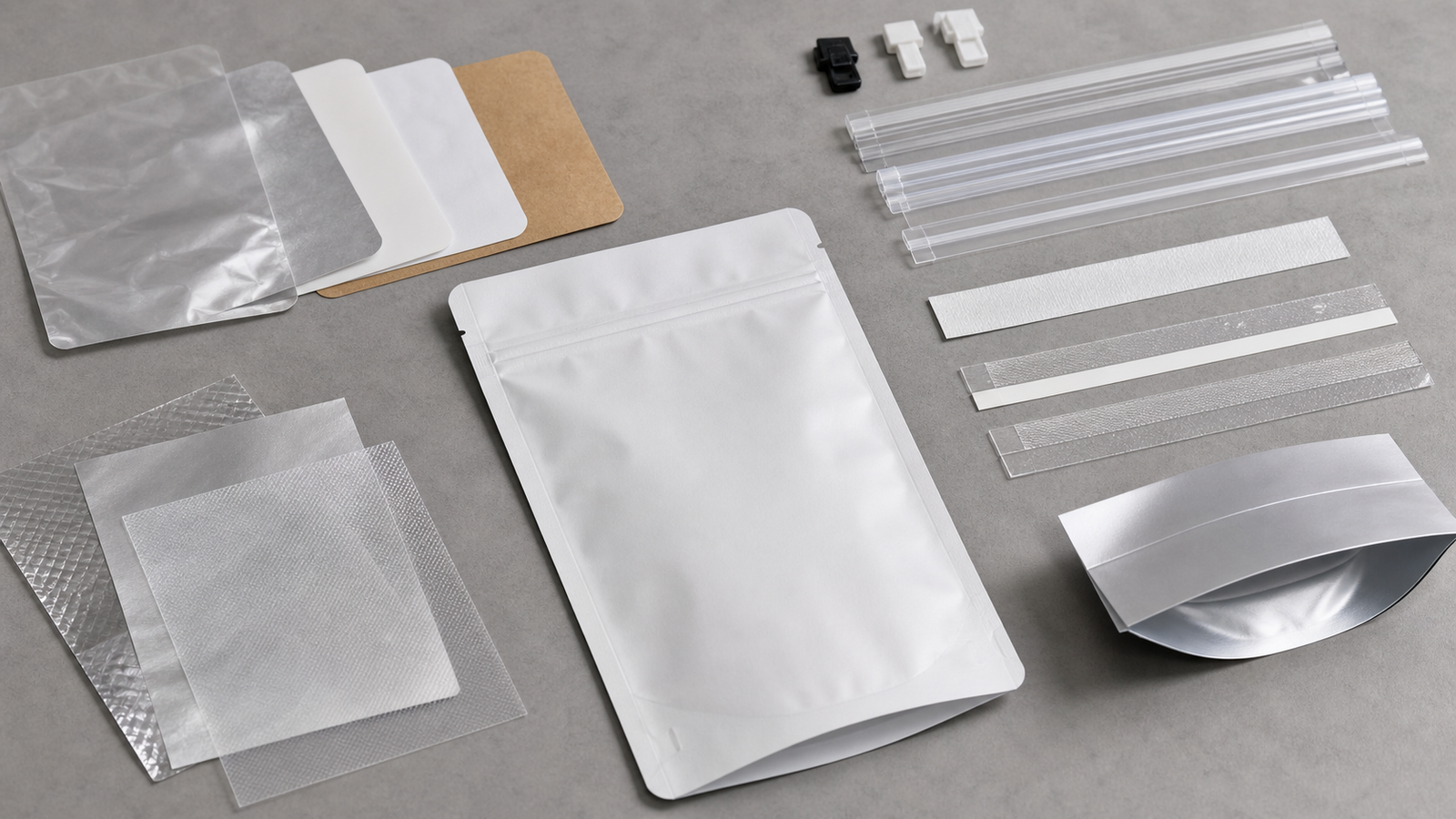
A custom pouch is a converted flexible package, not only a printed bag. It may use a single film, a coextruded structure, or a laminate such as PET/PE, PET/metallized PET/PE, PET/AL/PE, BOPP/PE, or a mono-material PE or PP structure. The right construction depends on what the product needs the pouch to do.
Write the pouch job in plain terms before discussing finishes:
- What must the pouch protect against: oxygen, moisture, light, aroma loss, grease, puncture, or chemical interaction?
- Must it stand upright, lie flat, hang, pour, dispense, or reseal?
- Will it be supplied premade, formed from rollstock, filled through the top, filled through a spout, or packed manually?
- Which seal areas carry load during filling, shipment, and display?
- What must the package prove before release: seal strength, leak resistance, shelf-life behavior, drop performance1, or product-contact suitability?
A pouch for granola, coffee, and liquid refill may share a similar net weight but still need very different specifications. Granola may need moisture protection and stiffness. Coffee may need aroma barrier and a degassing valve. A liquid refill may need wider seals, headspace control, fitment review, and leak checks.
The strongest early brief describes the filled package, not just the flat pouch. Product behavior, handling route, opening method, storage conditions, and filling equipment all belong in the first discussion.
Which Four Decisions Should Be Connected First?
The first four connected decisions are pouch format, material structure, closure or dispensing feature, and filling method. If one of these is fixed too early, the project can run into seal, sizing, equipment, artwork, or cost problems that were avoidable at the specification stage.
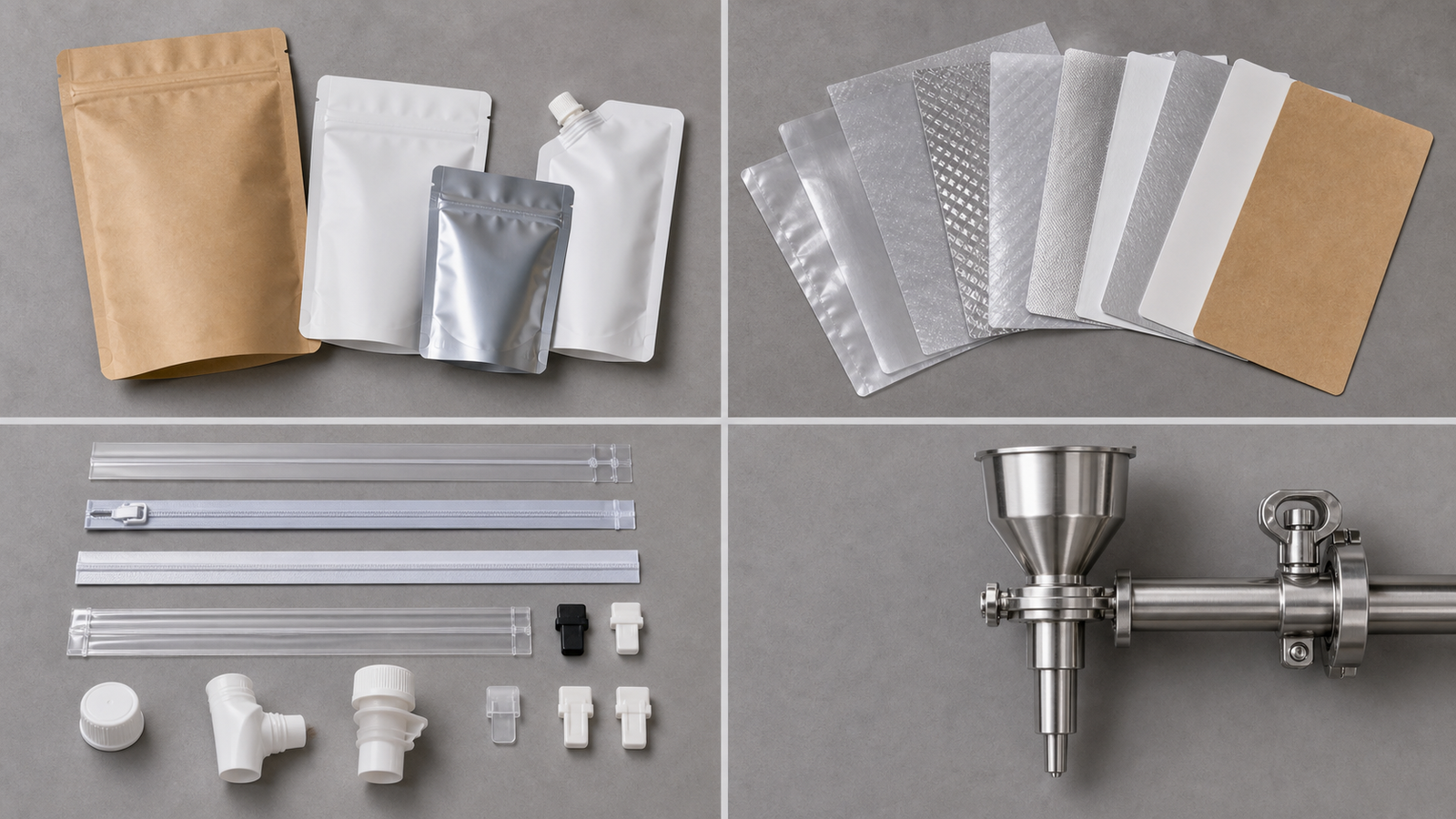
A custom pouch project should not start with one isolated question such as thickness, size, or print finish. Those details matter, but they sit downstream of the package system. Format, material, closure, and filling method should be reviewed together because each one changes the others.
| Early decision | Specification role | Risk if isolated |
|---|---|---|
| Pouch format | Sets posture, gusset use, seal layout, display area, and carton fit | The pouch may look right but fill or stand poorly |
| Material structure | Sets barrier, stiffness, sealability, puncture resistance, and machinability | The film may protect well but run poorly on the line |
| Closure or dispensing feature | Changes opening area, seal stress, user handling, and artwork layout | A zipper, valve, or spout may be added after the pouch is already constrained |
| Filling method | Sets opening tolerance, seal zone, heat exposure, speed, and pouch feeding | The selected format may not match the intended equipment |
A premade stand-up pouch with a zipper has different needs from rollstock used on a VFFS line. A spouted pouch for a viscous gel is not specified the same way as a flat sachet for a cosmetic sample. Even the same laminate can behave differently on different filling equipment terms2 and machine formats.
A practical early review confirms pouch family, material structure, seal design, converting details, and filling method in parallel. That does not mean every detail is final on day one. It means no single decision moves so far ahead that the rest of the system has to work around it.
Which Pouch Family Fits the Product Behavior?
The pouch family should be selected by product behavior, not only fill weight. Dry snacks, coffee, powders, liquids, gels, refills, samples, and sharp-edged dry goods can require different pouch formats because they flow, settle, leak, abrade, seal, and store differently.
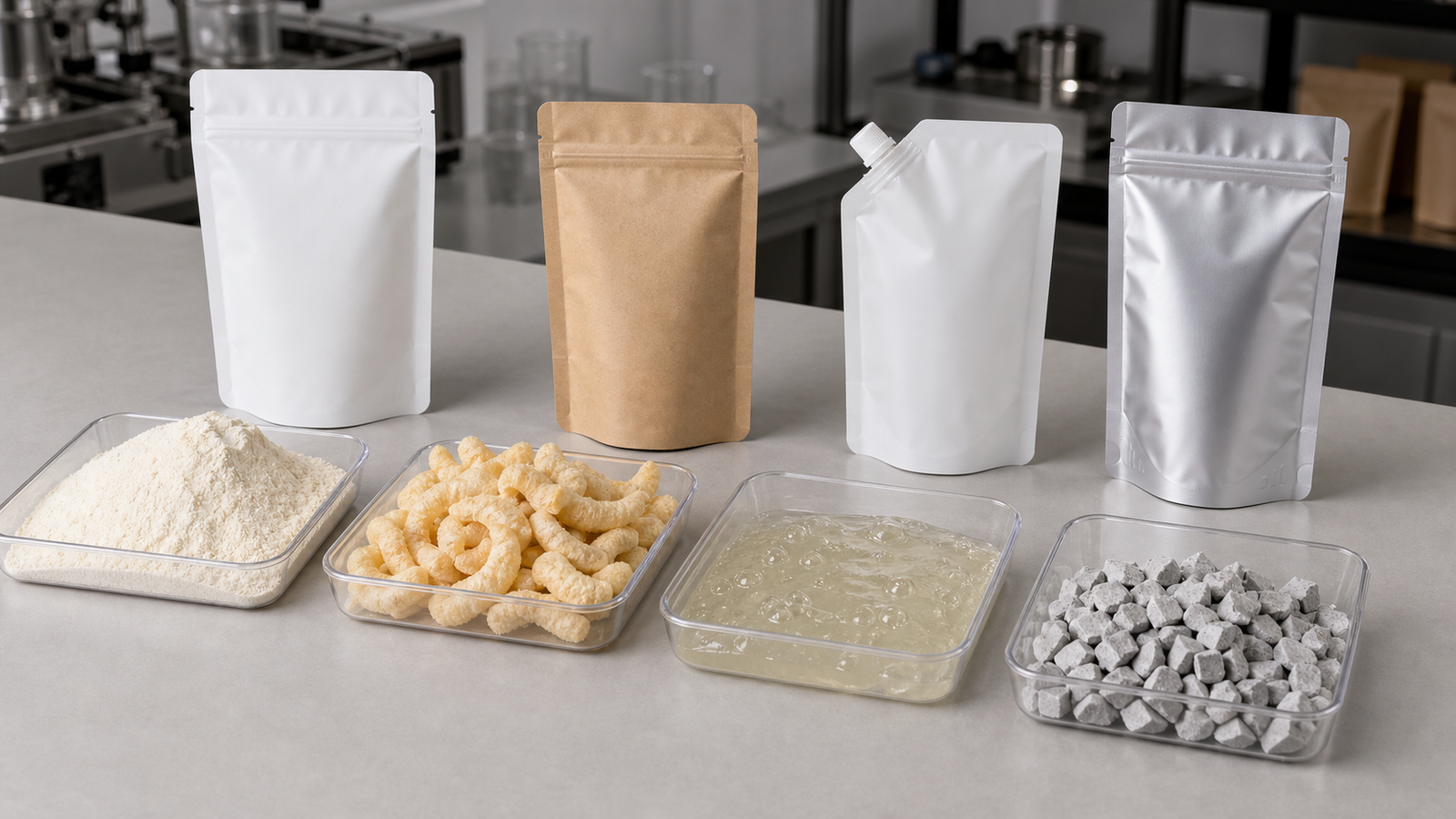
The product inside the pouch is usually the best first filter. A powder that traps air, a snack with sharp edges, and a liquid refill all create different stresses even when the target net weight looks similar. Format selection should follow how the product moves, settles, opens, and leaves the pack.
| Product behavior | Pouch families often considered | Specification focus |
|---|---|---|
| Dry snacks | Stand-up, pillow, flat-bottom | Moisture barrier, stiffness, seal contamination, shelf posture |
| Coffee or tea | Side-gusset, flat-bottom, stand-up | Aroma barrier, valve option, oxygen exposure, filled shape |
| Powders | Stand-up, sachet, stick pack, flat pouch | Dust in seal area, static, bulk density, headspace |
| Liquids or gels | Spouted, flat sachet, 4-side-seal | Leak resistance, seal width, fitment, fill temperature |
| Sharp-edged dry goods | Stand-up or reinforced laminate formats | Puncture resistance, toughness, drop handling |
| Samples or unit-dose packs | 3-side-seal, 4-side-seal, sachet | Portion control, tear behavior, perimeter seal strength3 |
Scenario: A product team plans the same pouch size for dense candy and lightweight protein powder because both use the same net weight. The powder may need much more filled volume, more headspace, and different panel stiffness. If size is set from net weight only, the pouch may bulge, lean, strain the zipper, or look partly empty.
Product behavior should also guide seal design. Powders can contaminate the seal area. Oils can challenge sealant choice. Liquids can expose weak corners during drops. Sharp products may need a tougher sealant layer or puncture-resistant layer such as PA, depending on the full structure.
When Should a Stand-Up Pouch Be the Starting Format?
A stand-up pouch is a strong starting format when shelf visibility, front-panel branding, lightweight distribution, and upright presentation matter. It is usually bottom-gusseted, so the final decision should still confirm filled posture, gusset behavior, seal stress, closure position, and carton fit.

Stand-up pouches combine a large front print area with lower weight than many rigid formats. They are common for snacks, powders, coffee, pet treats, nutraceuticals, refills, and specialty foods. Most are bottom-gusseted, meaning the base opens after filling and helps the pouch stand upright.
The format is useful when the project needs:
- A clear front panel for branding and product information
- Upright display without a box, jar, or tub
- Space for a zipper, tear notch, hang hole, or valve where appropriate
- Lower freight weight and compact empty-pack storage compared with rigid packaging
- A flexible structure that can support several sizes or SKUs
Still, stand-up pouch is not a complete specification. Doyen or round bottom, K-seal, plow bottom, and flat-bottom structures behave differently after filling. Product density matters too. A lightweight snack may stand well in a round-bottom style, while a dense product may need stronger base geometry or a different seal layout.
The filled sample matters more than the empty sample. An empty pouch can sit neatly on a desk, then pull forward, strain the zipper, or lose base stability after filling. For shelf-ready packs, confirm filled width, depth, height, center of gravity, case pack, and bottom-gusset pouch construction4 before artwork is locked.
Stand-up formats are useful, but they should earn their place through posture, protection, and filling compatibility rather than familiarity.
What Barrier Structure Supports the Shelf-Life Target?
Barrier structure should be matched to product risk and shelf-life target, not added as a generic upgrade. Oxygen sensitivity, moisture sensitivity, aroma retention, light exposure, grease resistance, product chemistry, fill temperature, and sealability should determine whether the pouch needs standard, high-barrier, foil, coated, or mono-material construction.

Barrier performance is one of the main material decisions in custom pouch work. A good-looking pouch can still fail if it allows moisture pickup, oxygen ingress, aroma loss, light damage, grease staining, or weak seals. The useful question is not which film sounds best. It is what the product needs the film to control.
Use OTR and WVTR when shelf life depends on oxygen or moisture. OTR means oxygen transmission rate5. WVTR means water vapor transmission rate. Values should include units, test method, temperature, relative humidity, and whether the number applies to flat film or the finished pouch. A film value alone does not prove final filled-pack shelf life.
| Material route | Barrier and structure role | Practical watch point |
|---|---|---|
| PET/PE | Print surface, stiffness, PE sealant layer | Moderate barrier; check product sensitivity |
| BOPP/PE | Clarity or stiffness with sealant function | Heat resistance and barrier vary by grade |
| PET/metallized PET/PE | Better light, oxygen, and aroma protection | Metal layer damage and flex cracking need review |
| PET/AL/PE | Very high light and barrier protection | End-of-life trade-offs and flex durability matter |
| EVOH or coated barrier film | Oxygen barrier in a thinner layer | Humidity sensitivity and converting behavior matter |
| Mono-material PE or PP | Recycling-stream compatibility in some markets | Barrier, stiffness, heat resistance, and sealing window may narrow |
A proper comparison should include sealant layer, seal width, seal geometry, stiffness, puncture resistance, machinability, product compatibility, shelf-life target, and sealing window. The sealing window is the range of temperature, pressure, and dwell time where seals form consistently without distortion or burn-through.
How Should Pouch Size Be Set for the Filled Pack?
Pouch size should be set from the filled pack, not only net weight or flat dimensions. Filled volume, bulk density, settling, headspace, gusset depth, seal width, zipper position, and carton fit all affect whether the pouch looks right and performs under handling.
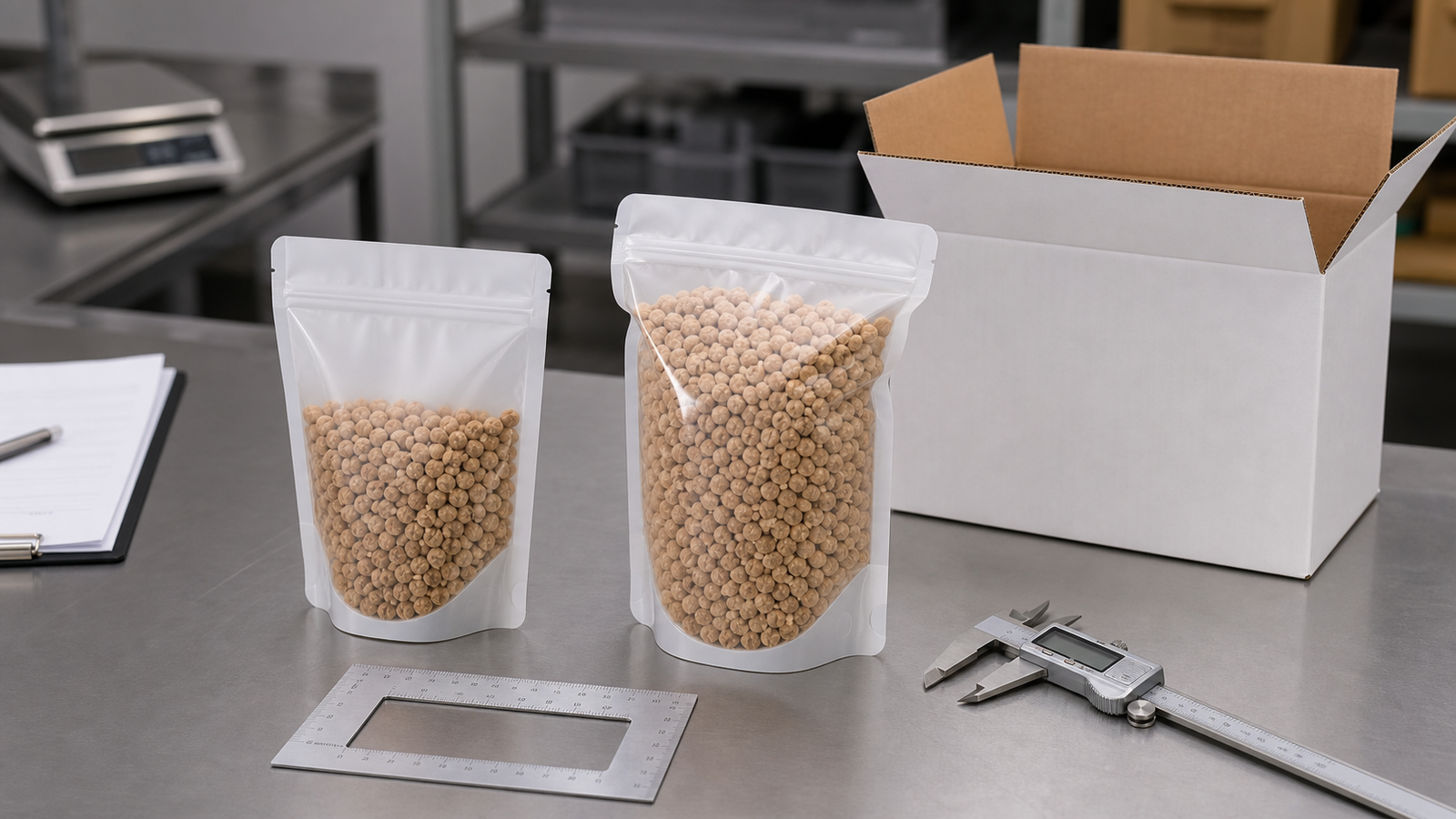
Flat dimensions are only part of pouch sizing. The same width and height can behave differently after filling depending on product density, particle shape, trapped air, pouch stiffness, gusset depth, and closure placement. A size that looks efficient on a dieline may become tight, unstable, or distorted as a filled pack.
Example: A 250 g pouch for dense roasted nuts may need much less internal volume than a 250 g pouch for puffed snacks or protein powder. If both products use the same pouch size, one may look underfilled while the other strains the zipper and top seal. The issue is not appearance alone. Seal strain, pouch posture, and carton fit can all change.
A sizing review should include:
- Product weight and true filled volume
- Bulk density, settling, and compaction behavior
- Required headspace for sealing6, handling, or product movement
- Gusset depth and how the base opens after filling
- Seal width and distance from product to seal area
- Zipper, tear notch, spout, valve, or hang-hole position
- Filled dimensions for shelf and carton planning
- Distribution route and compression risk
How much headspace is enough?
There is no universal headspace rule for custom pouches. The right range depends on product type, fill process, pouch format, and distribution conditions. Too little headspace can stress seals or closures. Too much can make the pack look slack or underfilled.
Filled-pack review should use real or representative product. For powders and granules, check settling after vibration. For liquids and gels, check displacement during drops or compression. For stand-up formats, confirm whether the filled base forms consistently and whether the pack remains stable in the carton.
How Should Artwork Be Built Around Production Limits?
Artwork should be built around the production dieline, not placed onto the pouch as a final decoration layer. Seal areas, cut lines, folds, gussets, zipper tracks, tear notches, spout zones, hang holes, and wrapped print zones must be respected before proof approval.
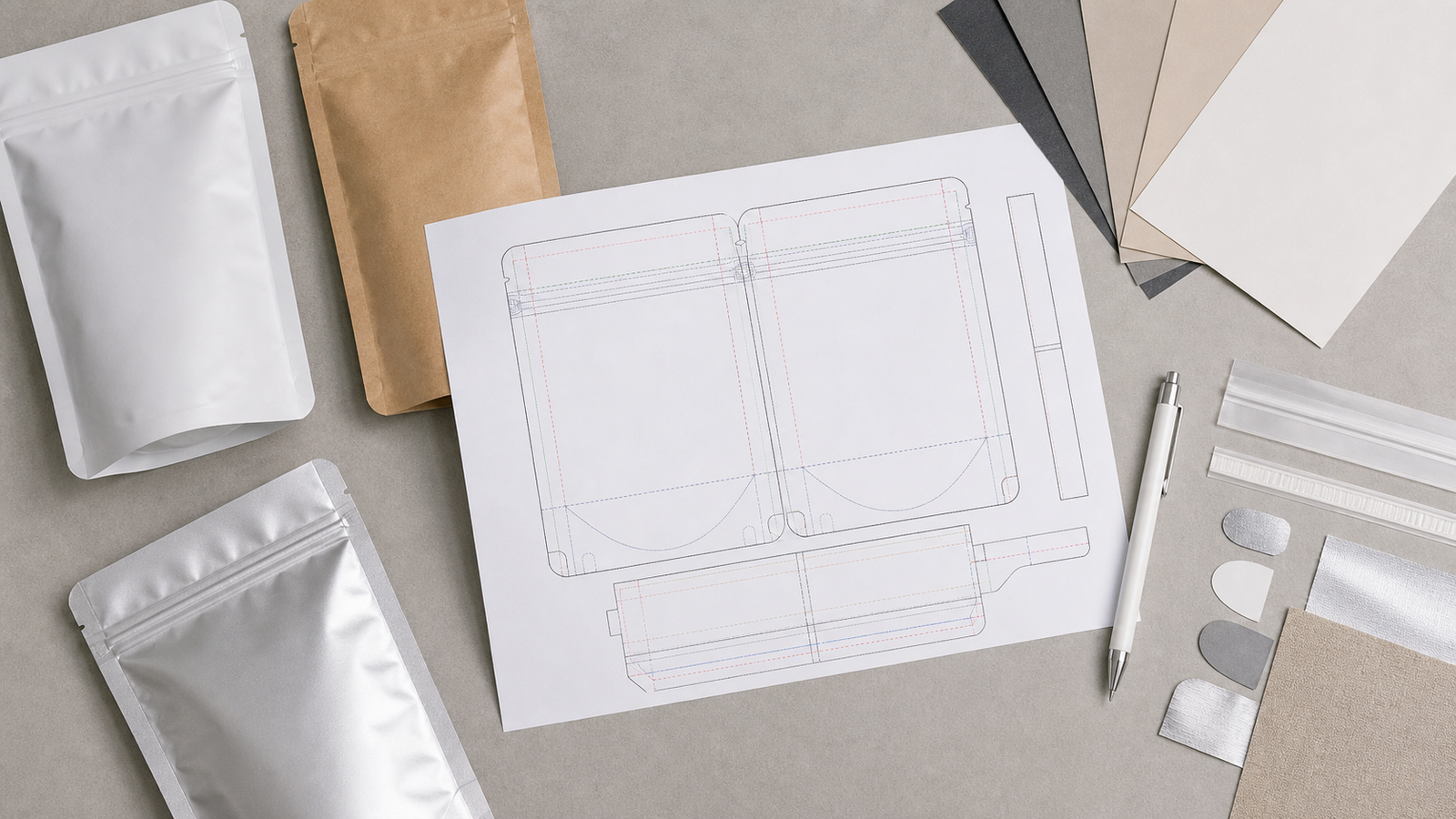
Artwork is part of the pouch specification. A print file that ignores converting and sealing limits can create waste, delays, or a pouch that looks different after formation. Flexible packaging artwork must follow the physical structure of the pouch, not only the visible front panel.
The dieline should identify cut lines, seal zones, folds, gussets, zipper locations, tear notches, spout or valve areas, hang holes, wrapped print zones, and barcode quiet zone7. Critical text, barcodes, icons, and required symbols should stay out of seal areas, folds, and distortion zones. Heavy ink coverage near seal zones may also need review, depending on the print and lamination system.
Useful artwork checks include:
- Bleed and safe zones around cut lines
- No required text across gusset folds unless intentionally planned
- Barcode size, contrast, orientation, and quiet area
- Registration tolerance for front, back, and side panels
- Matte, gloss, spot varnish, or soft-touch finish placement
- Clear window position, if used, relative to seal strength and product visibility
- Tear notch alignment with the intended opening path
- Zipper or spout clearance from graphics and required information
What often goes wrong in pouch artwork?
A common mistake is treating the flat artwork as if the filled pouch remains flat. Gussets expand, side panels wrap, and bottom folds distort the printed area. On flat-bottom pouches, side panels can become valuable information space, but only if they are planned from the correct dieline.
Proof review should cover both print appearance and production function. Color matters, but so do seal clearance, fold placement, readability, and how the filled pack faces outward in a carton or on shelf.
Where Should Labeling and Compliance Space Be Reserved?
Labeling and compliance space should be reserved before artwork approval, not squeezed into the file later. Food, supplement, cosmetic, chemical, pet care, and household products may need different panels, readable areas, warnings, ingredient blocks, symbols, and market-specific information.
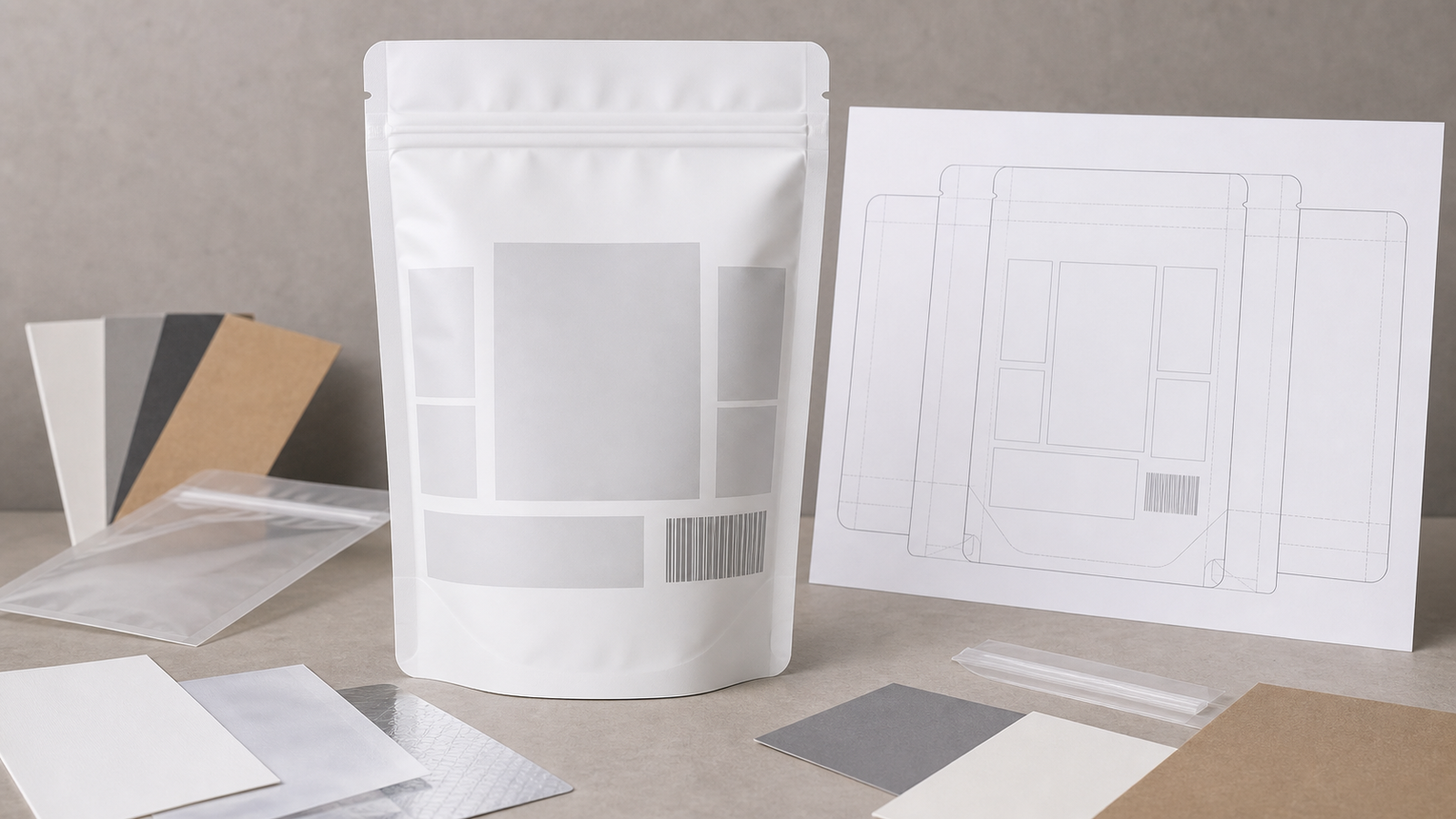
Required information can change the pouch layout as much as branding does. If the artwork is designed first and required content is added later, the result can be crowded panels, weak readability, awkward barcode placement, or text crossing a gusset fold or seal area.
The packaging team should identify labeling layout requirements8 early for the target market and product category. Exact requirements vary by product and jurisdiction, so this article is not legal guidance. From a packaging specification standpoint, the main point is to reserve clean, readable space before design approval.
Common space planning items include:
- Product identity and net contents area
- Ingredient or composition statement, where applicable
- Nutrition, supplement, safety, or usage information, where applicable
- Warning or precautionary language
- Storage instructions, lot code, date code, and traceability area
- Barcode or data matrix area with quiet zone
- Recycling, disposal, or material identification marks where appropriate
- Importer, distributor, or responsible party information where required
Small pouches, sachets, and shaped packs need special care. They may have less printable area than expected after seal zones, tear notches, and folds are removed from the usable layout. A stand-up pouch with a bottom gusset may also lose practical readability near the base after filling.
Check labeling space on the filled pack, not only in a flat PDF. Curved panels, pouch bulge, matte or gloss finish, and product distortion behind a window can all affect readability. The best layout keeps required information stable, plain, and easy to inspect.
What Product-Contact Checks Are Needed Before Approval?
Product-contact suitability should be checked before artwork or tooling approval. The review may include films, sealant layers, adhesives, inks, coatings, varnishes, recycled content if used, and closures such as zippers, valves, spouts, caps, or other fitments.

Product-contact review is a material selection gate. It should not be left as a paperwork request after artwork is finished and tooling is ready. The pouch must be suitable for the product, the intended use, and the target market before production release.
For food, supplement, pet care, cosmetic, household, and chemical products, different risk questions may apply. Dry food contact is not the same as fatty food contact. Acidic products, hot-fill products, freezer storage, microwave-related use, and direct contact with oils or solvents may require different checks. Non-food products may need chemical compatibility, odor control, migration review9, or safety labeling support.
The review may include:
- Outer print web, where set-off or migration risk is relevant
- Barrier layer and adhesive system
- Sealant layer in direct contact with the product
- Inks, coatings, varnishes, and primers
- Recycled content, if used
- Zipper, valve, spout, cap, or fitment material
- Intended temperature exposure during filling, storage, and use
- Target market documentation requirements
A declaration or compliance document is only useful when it matches the real structure and intended use. A general statement for a film family may not cover a specific ink system, adhesive, recycled-content layer, closure, or high-temperature process.
Do not ask a supplier to confirm suitability from a vague product name alone. Provide the formula type, key ingredient or sensitivity concerns, fill temperature, storage conditions, and target market so the material review can be tied to actual use conditions.
Which Closure or Dispensing Feature Should Be Chosen Early?
Closure and dispensing features should be chosen early because they change pouch format, material, filling method, artwork layout, safety expectations, and cost. Zippers, tear notches, laser scores, hang holes, valves, spouts, caps, tamper-evident parts, and child-resistant closures are specification decisions.
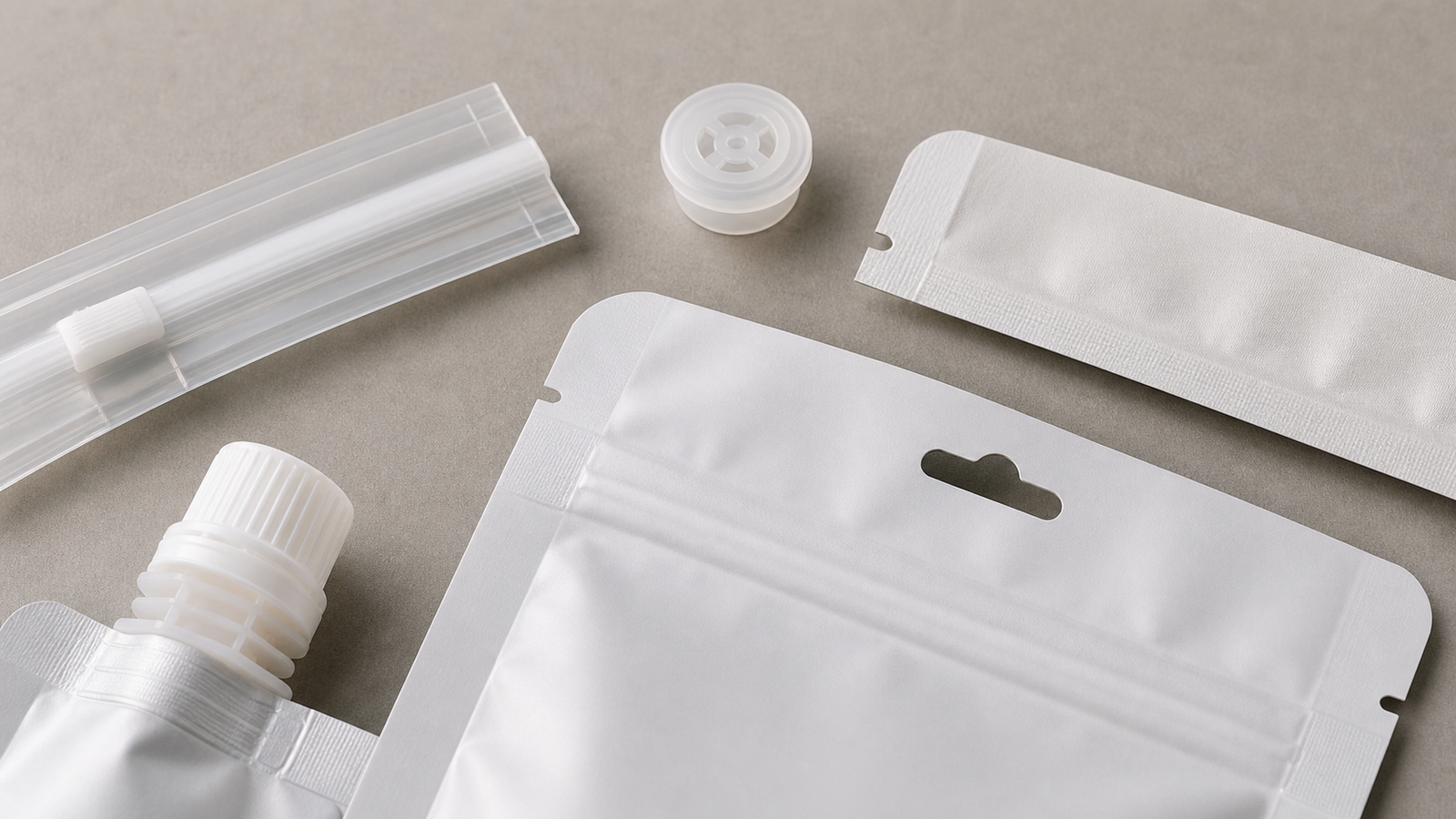
Closures are often treated as accessories, but they can define the pouch. A zipper changes top seal geometry and open area. A spout changes fitment welding, filling, capping, and leak risk. A valve changes material placement and product degassing behavior. A tear notch changes opening direction and required seal margin.
| Feature | Common purpose | Specification checks |
|---|---|---|
| Zipper | Reclose after opening | Top seal clearance, powder contamination, zipper height, opening feel |
| Tear notch | Controlled first opening | Notch position, tear direction, seal margin, artwork clearance |
| Laser score | Easier opening path | Film structure, score depth, barrier impact, tear control |
| Hang hole | Peg display | Reinforcement, seal area, product weight, retail orientation |
| Degassing valve | Release gas from coffee or similar products | Valve placement, aroma barrier, application method, pack posture |
| Spout and cap | Pouring or dispensing liquids, gels, or pastes | Fitment size, weld area, cap torque, fill path, leak testing |
| Tamper-evident feature | Show opening evidence | Target market expectations, cap or seal design, handling durability |
| Child-resistant closure | Restrict access in risk categories | Applicable standard, user group, fitment compatibility, validation plan |
Closure choice also affects material. A zipper may need a sealant layer that bonds reliably to the zipper profile. A spout pouch may need stronger fitment welding and enough stiffness around the spout area. A laser score may not behave the same across foil, metallized film, mono-material PE, and multi-layer laminate structures.
The right closure is not the most feature-rich option. It is the feature that fits product risk, opening behavior, filling process, and market expectations without creating unnecessary converting complexity.
Where Is Customization Worth the Added Cost?
Customization is worth the added cost when it improves product protection, filling performance, shelf impact, handling, dispensing, or SKU strategy enough to justify added tooling, longer lead time, higher waste risk, larger minimum order quantity, and more approval work.
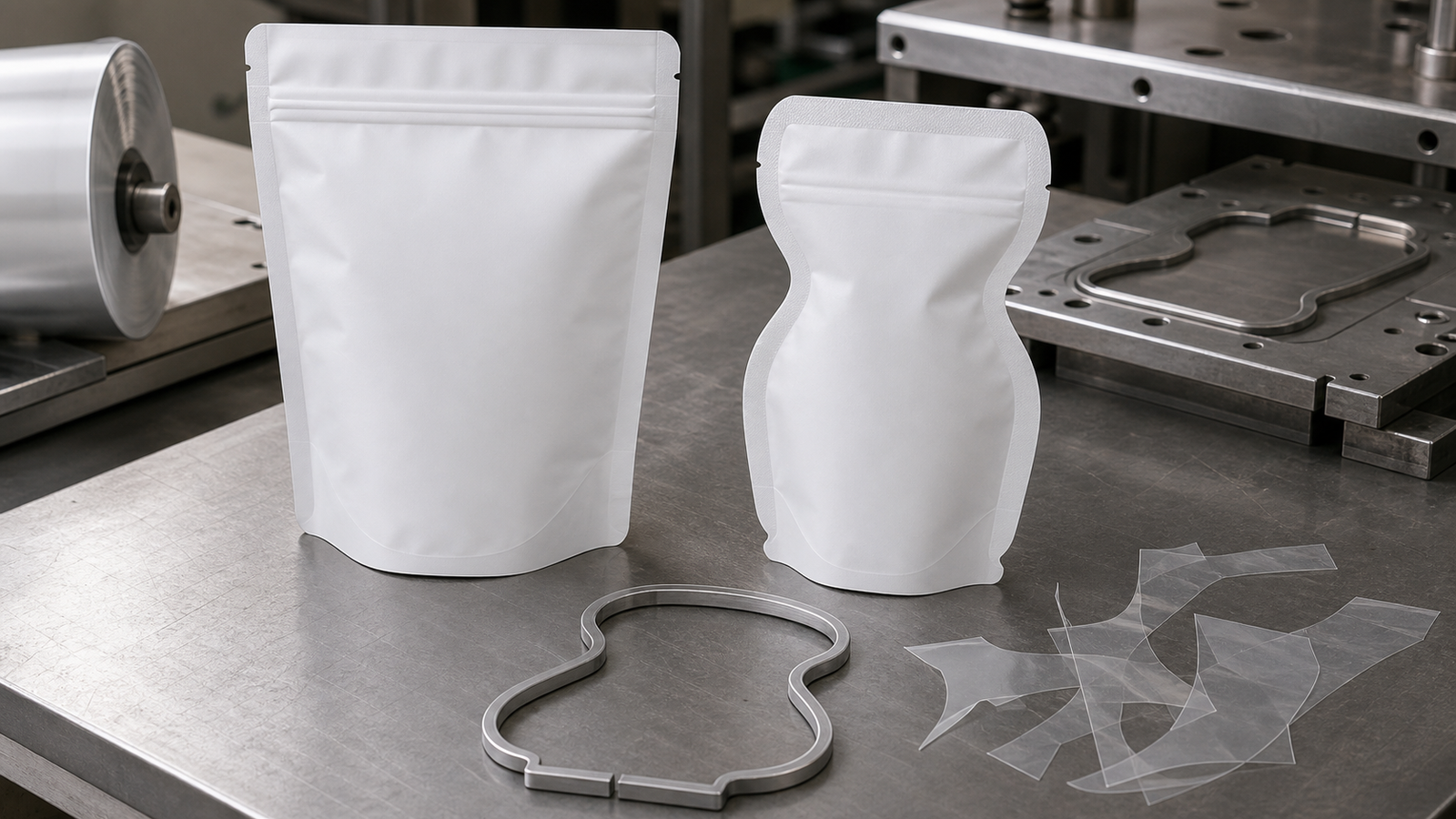
Not every custom detail creates useful value. Some changes solve a packaging problem. Others add cost and risk without improving the pack. The practical question is where the pouch needs to depart from standard production and where existing options already do the job.
Standard pouch sizes, common laminate structures, existing zipper options, established spout sizes, and proven print setups can reduce lead time and technical risk. Custom shapes, unusual dimensions, special finishes, multiple artwork versions, heavy ink coverage, high-barrier structures, or uncommon closures can be justified, but only when they support a clear package objective.
Useful customization usually falls into one of these categories:
- Protection: barrier, puncture resistance, seal strength, or product-contact needs
- Function: zipper, spout, valve, tear path, hang hole, or controlled dispensing
- Fit: filled dimensions, carton efficiency, shelf posture, or equipment compatibility
- Communication: panel layout, finish, window, or multi-SKU print strategy
- Market requirement: target market documentation or sustainability goal
Shaped pouches are a good example. A die-cut outline can improve shelf recognition, but it can also add die work10, tighter print registration, more scrap risk, and a higher minimum order quantity. For a short seasonal SKU, a standard stand-up pouch with strong artwork may be a better technical decision.
Cost control is not only about reducing features. It is about spending complexity where it changes performance or market fit. A custom pouch should be intentionally different, not accidentally complicated.
Which Print Method Fits the Run Length and Project Needs?
The print method should fit run length, artwork versioning, color expectations, lead time, material structure, and converting plan. Digital, flexographic, and rotogravure printing can all work for custom pouches, but each method supports different project conditions and approval risks.

Printing is connected to the laminate and converting plan. A method that fits a short launch run may not fit a high-volume recurring program. A method that gives strong economics at scale may require longer setup, cylinders, plates, or stricter version control.
| Print method | Often useful for | Specification advantages | Watch points |
|---|---|---|---|
| Digital | Short runs, test launches, many artwork versions | Fast setup, no plates, efficient versioning | Ink system, material fit, unit cost at larger scale |
| Flexographic | Medium to large runs, repeat SKUs | Good speed, broad film use, balanced cost | Plate cost, registration control, color management |
| Rotogravure | Large runs, high image consistency | Strong print quality and repeatability at scale | Cylinder cost, longer setup, less flexible version changes |
The right method depends on more than artwork. Laminate structure, reverse printing, surface printing, varnish, matte or gloss finish, heat exposure during lamination, and coefficient of friction11 can all influence the final result. If the pouch includes windows, metallic effects, heavy ink coverage, or small required text, proof review needs extra attention.
Should print method be chosen before the laminate?
Usually, print and laminate should be reviewed together. A reverse-printed PET layer laminated to PE is different from surface printing on a mono-material structure. Heat resistance, ink adhesion, seal-zone cleanliness, and film handling can all matter during filling and converting.
Color approval should also be realistic. Digital, flexographic, and rotogravure results may not match exactly across substrates and finishes. If a program may move from digital launch runs to flexographic or rotogravure scale runs later, plan color standards and artwork separations with that transition in mind.
What Sample Validation Should Happen Before Full Production?
Sample validation should include proof review, empty-sample review, and filled-pack testing before full production. Empty samples can check appearance and construction, but filled samples give better evidence of posture, seal stress, gusset behavior, headspace, closure function, and handling strength.
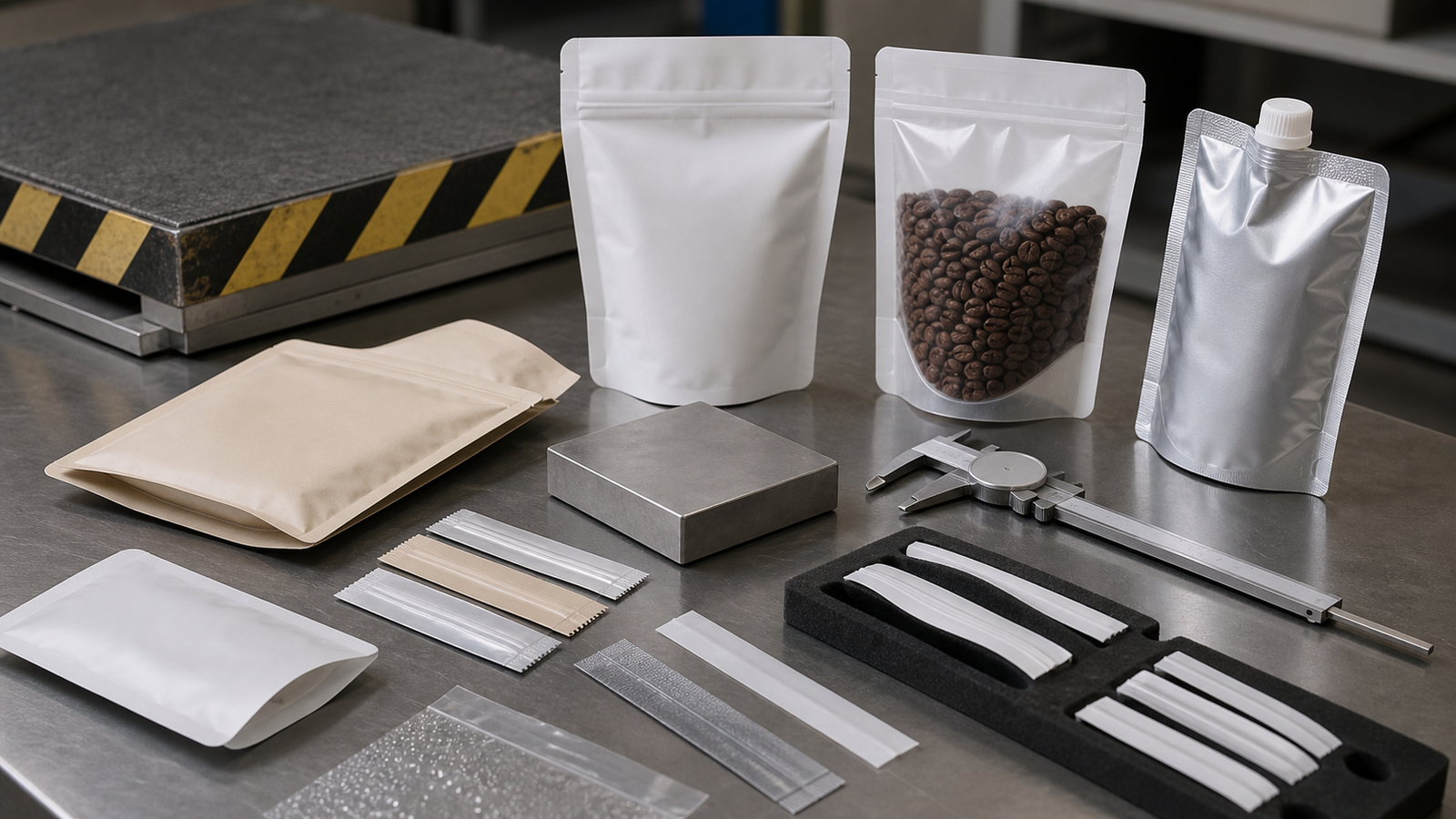
A sample pouch is not production approval by itself. Empty samples are useful, but they cannot show every risk that appears after filling, sealing, packing, and distribution. I would separate visual proofing, empty-pouch review, and filled-pack validation.
Practical approval checklist:
- Review artwork proof against the approved dieline, safe zones, barcode area, print finish, and version details.
- Check empty samples for pouch dimensions, material feel, stiffness, zipper or closure function, tear notch placement, spout or valve position, and general formation.
- Fill samples with real or representative product at intended fill weight or volume.
- Confirm filled posture, gusset opening, headspace, panel distortion, zipper strain, and top seal clearance.
- Run seal strength review12, visual seal inspection, leak check, or burst-related evaluation where relevant.
- Check product residue in the seal area after filling, especially with powders, oils, sauces, or dusty products.
- Review closure performance after repeated opening and reclosing when the feature is intended for reuse.
- Pack filled samples into the intended carton or shipper to check stack pattern, compression, and fit.
- Consider drop, vibration, or transport simulation for products with leak, breakage, or distribution risk.
- Confirm required documentation before release, including material, product-contact, print, and sustainability information where applicable.
A stand-up pouch may look clean as an empty sample but lean forward after filling with dense powder. A zipper that opens smoothly when empty may become tight when product pushes against the top panel. Those are filled-pack issues, not artwork issues. The approval process should catch them before full production.
How Should Filling Compatibility Be Confirmed Before Format Lock?
Filling compatibility should be confirmed before the pouch format is locked. Premade pouch filling, VFFS, HFFS, flow-wrap, sachet, stick-pack, and manual filling can require different pouch dimensions, film behavior, seal areas, opening features, coefficient of friction, and handling tolerances.
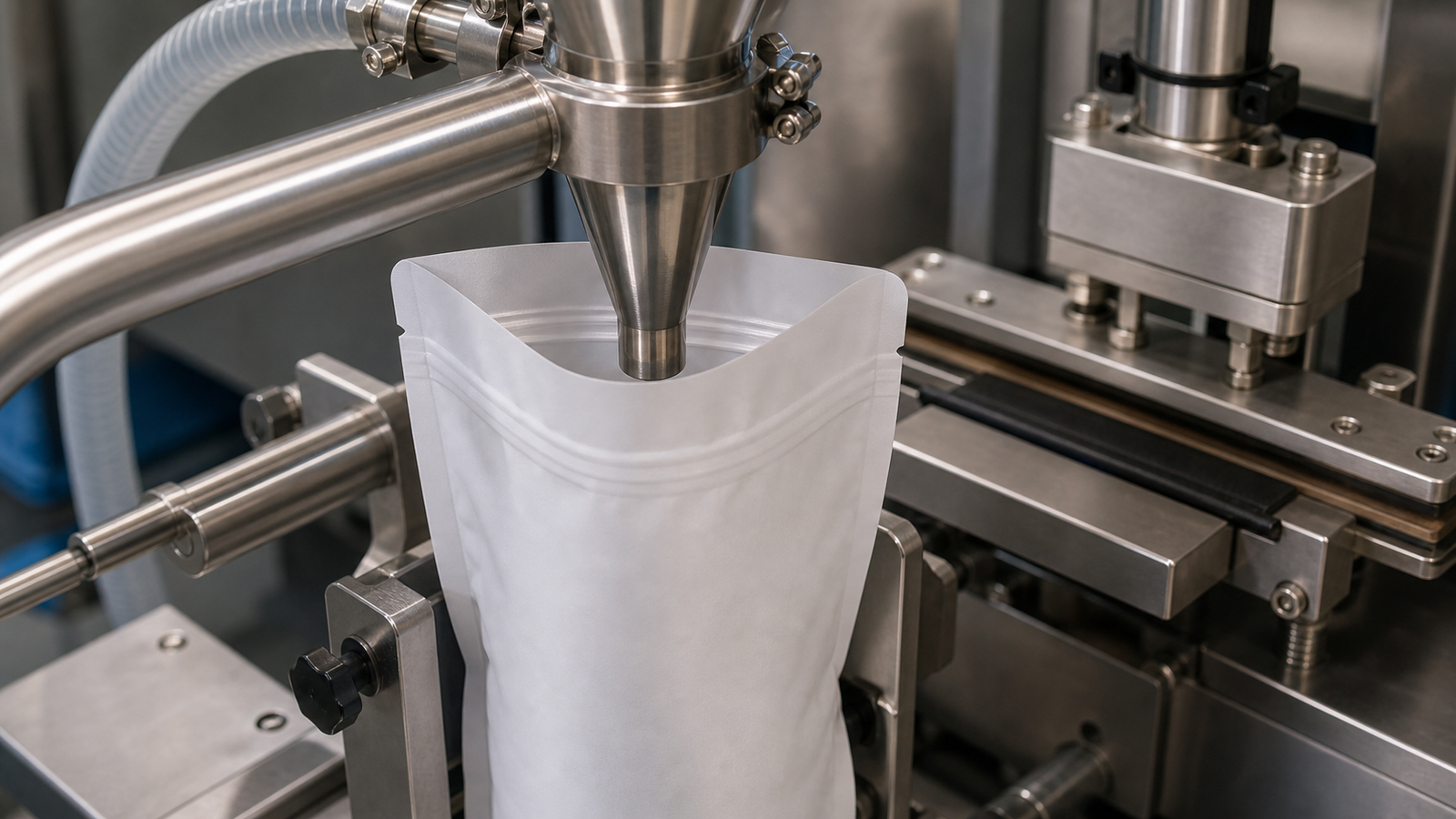
A pouch that looks right in a sample room may still fail to run efficiently on the intended line. Filling method affects nearly every practical detail: pouch opening, film stiffness, sealant behavior, seal area, temperature exposure, product residue, speed, coding, inspection, and finished-pack handling.
| Filling method | Common pouch or film route | Compatibility checks |
|---|---|---|
| Premade pouch filling | Stand-up, flat, flat-bottom, spouted formats | Opening tolerance, zipper clearance, pouch feeding, top seal area |
| VFFS | Rollstock pillow or gusseted packs | Film stiffness, COF, forming, lap or fin seal, jaw temperature |
| HFFS or flow-wrap | Rollstock flat or wrapped formats | Registration, seal geometry, product spacing, cut accuracy |
| Sachet or stick-pack | Small portion packs | Film tracking, seal width, tear behavior, dose accuracy |
| Manual filling | Premade flexible formats | Operator handling, seal consistency, residue control, repeatability |
COF means coefficient of friction. It affects how film or pouches move through equipment. A film that is too slippery or too grabby can create feeding problems. Sealant choice also matters because a narrow sealing window can reduce speed or create inconsistent seals.
Scenario: A team selects a premium flat-bottom pouch before confirming the co-packing line. The intended line may only handle simpler premade stand-up formats or rollstock. The result can be a late format revision, slower filling, or added manual handling.
Before format lock, confirm fill temperature, product residue risk, target line speed, seal jaw temperature13 range, pressure, dwell time, pouch opening method, coding location, and inspection needs. Filling is part of the specification, not an afterthought.
How Should Sustainability Be Treated as a Technical Constraint?
Sustainability should be treated as a technical constraint that must still protect the product, run on the filling process, meet shelf-life needs, and support a valid market claim. Mono-material, recycled-content, compostable, paper-based, and high-barrier structures all involve trade-offs.

Sustainability goals should enter the specification early because they can narrow material choices. A pouch cannot be evaluated only by whether it sounds sustainable. It still has to protect the product, seal reliably, run through filling equipment, survive distribution, and support a claim that is valid in the target market.
| Material direction | Possible reason to consider it | Specification trade-offs to review |
|---|---|---|
| Mono-material PE | Recycling-stream compatibility14 in some markets | Stiffness, heat resistance, barrier, sealing window |
| Mono-material PP | Compatibility with some PP recycling routes | Seal behavior, film availability, clarity or stiffness needs |
| Recycled-content structure | Reduced virgin material use where allowed | Product-contact limits, documentation, consistency |
| Compostable material | Specific composting claim route | Certification, infrastructure, barrier, heat resistance |
| Paper-based laminate | Paper-forward appearance or material reduction goal | Barrier, grease resistance, sealability, moisture exposure |
| Conventional high-barrier laminate | Strong product protection | End-of-life limitations and mixed-material construction |
A recyclable claim is market-specific and collection-stream-specific. Compostable does not automatically mean home-compostable, recyclable, or suitable for direct product contact. Recycled content may be limited by product-contact rules or by the layer where it is used.
The technical review should compare barrier, sealant layer, seal width, seal geometry, stiffness, puncture resistance, machinability, product compatibility, shelf-life target, and sealing window. If a mono-material option narrows the sealing window too much for the filling line, it may create waste or seal failures. If a compostable film cannot meet moisture barrier needs, product protection may be compromised.
A valid sustainability decision keeps product protection first. Wasted product is also a sustainability failure.
Where Do Custom Pouches Create Real Packaging Value?
Custom pouches create value when lightweight structure, strong print area, format variety, distribution efficiency, and flexible application options solve real product or channel needs. They can support many categories, but the pouch still needs to fit product behavior, filling, shelf life, and validation.

Custom pouches are useful because they combine flexible format options with strong print space and efficient empty-pack storage. Compared with many rigid formats, they can reduce packaging weight and may improve shipping efficiency. They also allow functional additions such as zippers, valves, spouts, tear notches, hang holes, windows, special finishes, and shaped outlines.
Good applications often include:
- Snacks and dry foods needing shelf presence and moisture protection
- Coffee and tea needing aroma protection and possible valve use
- Powders needing attention to bulk density, dust, and seal quality
- Pet food or treats needing stronger films and larger filled formats
- Nutraceuticals needing barrier, labeling space, and product-contact review
- Liquid refills or sauces needing leak control, fitments, and filling compatibility
- Samples needing small-format seal control and clear opening behavior
- Personal care and household products needing dispensing, chemical compatibility, or refill convenience
Custom pouches are not automatically the best answer. Very heavy products, sharp products, high-temperature processes, aggressive chemicals, or strict distribution routes may need stronger validation or a different package format. A pouch can be lightweight and still technically demanding.
The best value appears when the pouch format supports more than appearance. A stand-up pouch can support shelf display and resealability. A flat sachet can support portion control15. A spouted pouch can support refills or dispensing. A flat-bottom pouch can support a more structured shelf footprint.
Use custom pouches where flexibility changes the package function, not only where the project wants a different look.
What Specification Facts Belong in a Custom Pouch RFQ?
A useful custom pouch RFQ should describe the product and use conditions clearly enough for a supplier to recommend a workable structure. Include product behavior, fill details, pouch family, material needs, closure, print, filling process, distribution route, target market, sustainability goals, and documentation needs.

A vague RFQ produces vague proposals. A request for a custom pouch price is not enough technical information. A stronger RFQ gives the supplier enough facts to recommend a pouch format, laminate, closure, print method, and validation route that fit the product.
Complete RFQ checklist:
- Product type and product form: dry snack, powder, coffee, liquid, gel, refill, sample, pet treat, household product, or other category.
- Formula concerns: oil, grease, aroma, acidity, solvents, sharp edges, light sensitivity, moisture sensitivity, oxygen sensitivity, or dust.
- Fill weight or volume, plus bulk density or filled volume if known.
- Target pouch family: stand-up, flat, flat-bottom, side-gusset, sachet, spouted, shaped, or rollstock format.
- Target flat size and target filled dimensions, if available.
- Headspace, gusset depth, seal width, and closure placement expectations.
- Closure or dispensing needs: zipper, tear notch, valve, spout, cap, hang hole, laser score, tamper-evident feature, or child-resistant closure.
- Shelf-life target and barrier priorities, including OTR and WVTR requests16 with test conditions if relevant.
- Print method preference, artwork status, proof expectations, finish, window, and SKU count.
- Filling method, fill temperature, seal temperature range if known, line type, and planned line speed.
- Distribution route, carton pack, storage temperature, and shipment risk.
- Target market and required documentation, including product-contact and sustainability information where applicable.
- Order quantity, repeat program expectation, and timing.
If sealing or leakage risk is important, ask how the proposed structure will be validated. If sustainability is important, ask for specific material data and claim support for the target market. A good RFQ lets technical comparison happen before price comparison.
For a practical recommendation, sample plan, or quotation, send the product type, fill weight or volume, target pouch size, pouch family, material or barrier need, closure or dispensing features, artwork status, filling method, target market, quantity, and required documentation.
References
-
Flexible Package Integrity Testing | Applus+ Keystone - ... ASTM F2096 package integrity testing detects gross leaks in packaging down to 250 microns. This standard is used for tray and pouch packages. ASTM D3078 ... ↩
-
VFFS vs Premade Pouch Filling | Which is Best? | Paxiom - VFFS (Vertical Form Fill Seal) systems create packages from rollstock film. The machine forms the film into a bag, seals the sides, fills it— ... ↩
-
Standard Test Method for Seal Strength of Flexible Barrier Materials - This test method measures the force required to separate a test strip of material containing the seal. It also identifies the mode of specimen failure. ↩
-
Comparing Stand-up Pouch Styles - Eagle Flexible Packaging - Doyen pouches feature a rounded, U-shaped bottom gusset that seals to the front and back panels, creating a soft, upright presentation. ↩
-
D3985 Standard Test Method for Oxygen Gas Transmission Rate ... - This test method covers a procedure for determination of the steady-state rate of transmission of oxygen gas through plastics in the form of film, sheeting, ... ↩
-
Flexible Package Integrity Testing Guide | Burst, Leak & Seal Strength - Flexible package integrity testing evaluates the ability of flexible and semi-flexible packaging systems — pouches, bags, blister packs, and ... ↩
-
Creating and printing barcodes | GS1 Australia - The minimum size of the quiet zone depends on the size of the barcode. It is recommended to allow slightly more than the minimum required quiet zones, in case ... ↩
-
The Role of Labels in Product Packaging: Key Essentials - For example, the EU's Food Information to Consumers Regulation mandates specific font sizes for mandatory information, ensuring readability whilst creating ... ↩
-
What You Need To Know About Chemical Migration In Food ... - Bostik - Discover how packaging components such as barriers, adhesives, and inks can impact chemical migration levels in food packaging, and learn how adhesives can ... ↩
-
Rollstock Packaging vs Pre-Made Pouches: Which To Choose - Rollstock packaging generates scrap during setup, film threading, and edge trimming. Pre-made pouches generate significantly less forming scrap at the filling ... ↩
-
D1894 Standard Test Method for Static and Kinetic Coefficients of ... - The coefficients of friction are related to the slip properties of plastic films that are of wide interest in packaging applications. These methods yield ... ↩
-
ASTM F88 Seal Strength of Flexible Barrier Materials - Instron - ASTM F88 is a widely recognized standard that measures the peel strength of flexible packaging materials at typical ambient temperatures. ↩
-
Heat sealing evaluation and runnability issues of flexible paper ... - This paper aimed to optimize the sealing parameters and evaluate the runnability of flexible paper-based packaging materials with a polyethylene coating. ↩
-
PE Flexible - Association of Plastic Recyclers (APR) - 90% (by weight) of PE flexible mono-material PE is compatible with flexible film collection streams and easily recycled into a variety of end use applications. ↩
-
Pouch & Sachet Film Laminations - Flexible Packaging - Glenroy, Inc. - Sachet packaging is the preferred choice for brands delivering small quantities of product in single-serving or single-use applications. ↩
-
Food Packaging Barrier Testing Explained: OTR vs WVTR - Barrier testing measures how well your packaging keeps oxygen (OTR: Oxygen Transmission Rate) and moisture (WVTR: Water Vapor Transmission Rate) ... ↩